Your website still works. It loads, the contact form sends, and people find you on Google. But it was built four years ago, nobody on the team wants to touch it, and the last campaign needed a workaround because the site couldn’t do what marketing asked.
That’s usually when a website redesign comes up, and it’s where the standard advice (“redesign every two to five years”) falls short. Age isn’t the test. Lost enquiries are. Below is how to tell which you have, the four options, what each costs and what goes wrong.
What is a website redesign? A website redesign changes how a site looks, what it says and how its pages are organised, usually on the same platform. A rebuild goes further and replaces the platform or code underneath. Both should keep the pages and web addresses that already bring in traffic.
In this guide
- Fix, refresh, redesign or rebuild: the four options and what they cost
- A real redesign: Platinum DJ Services
- Where website redesigns go wrong
- How to decide what your website needs
- Plan for AI search while you’re redesigning
Fix, refresh, redesign or rebuild: the four options and what they cost
A full redesign is only one of four ways to fix a website that isn’t pulling its weight. The right one depends on whether the site is failing at its job or just looks dated, and on what’s underneath it.
The test is lost enquiries, not the age of the site
Plenty of five-year-old websites still bring in steady work, and plenty of new ones don’t. Look at what the site is doing for the business before you look at how it looks. These are the signs that point to a redesign:
- Traffic arrives but few people enquire, call or book.
- Every campaign needs a workaround, or simple changes need a developer.
- The site no longer describes what you sell, or who you sell to.
- Pages fail Google’s Core Web Vitals. A good score means the main content loads within 2.5 seconds, the page responds to a tap within 200 milliseconds, and the layout doesn’t jump around as it loads.
- It runs on an old WordPress setup with plugins nobody updates. Patchstack found 91% of new WordPress vulnerabilities in 2025 were in plugins, and 46% had no fix when they were made public.
One sign on its own rarely justifies a full redesign. If one service page converts badly, rewrite that page first and measure it for a month. If four or five of these signs show up together, patching won’t keep up.
Speed is worth taking seriously. When Vodafone made its main content load 31% faster, it recorded 8% more sales. Design for both screens, too: in Australia, StatCounter puts phones and desktops almost level, at 48.6% and 48.5% of page views in September 2026.
The four options
Whether you call it a website refresh, a website revamp or a full rebuild, the work falls into four sizes. The table shows what each involves and what we charge.
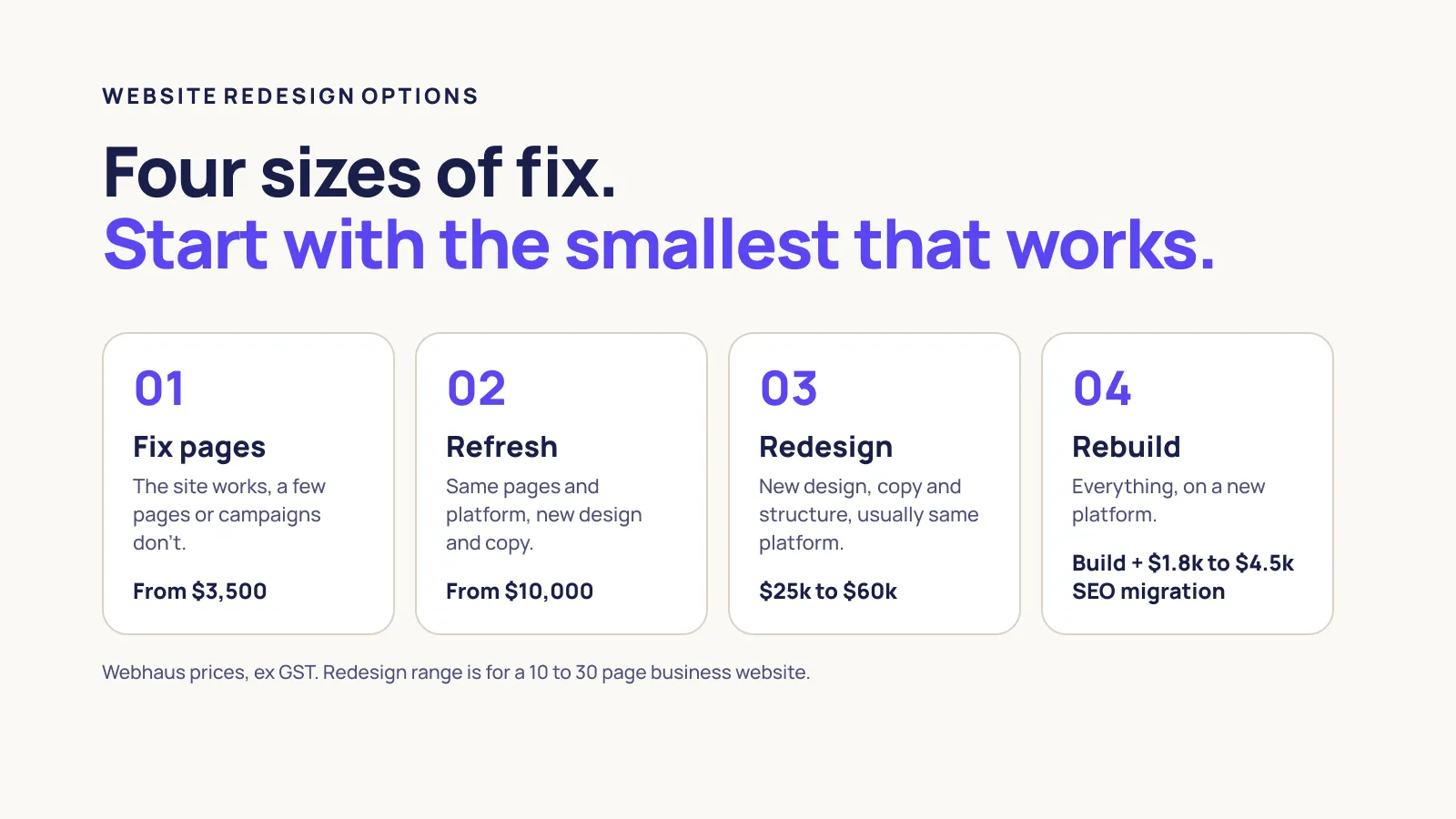
| Option | Fits when | What changes | Webhaus price (ex GST) | Typical time |
|---|---|---|---|---|
| Fix specific pages | The site works, but a few pages or campaigns don’t | New landing pages or rewritten key pages | Landing pages from $3,500 | 1 to 2 weeks |
| Refresh | The structure works, the look and copy are dated | Design and copy, same pages and platform | From $10,000 | Depends on scope |
| Redesign | The site no longer sells what you do, or how you sell it | Design, copy, page structure and CMS, usually same platform | $25,000 to $60,000 for 10 to 30 pages | Around 6 to 8 weeks |
| Rebuild on a new platform | The platform or code is holding you back | Everything above, plus a new platform | Build price plus $1,800 to $4,500 for SEO migration | Around 6 to 8 weeks, plus migration checks |
What pushes a redesign towards the top of the range
The number of unique page templates matters more than the number of pages. A 30-page site built from six templates usually costs less than a 15-page site where every page is different.
Copywriting is the next big lever. A redesign that keeps the old words usually gets the old results, so most of ours include new copy, and that’s where much of the budget goes. Integrations with a CRM, booking system or ERP add to the price, and so does moving years of blog posts or products across by hand.
Changing platform adds the most risk rather than the most cost. Every old address that changes needs a permanent redirect to its new one, and that work is what the $1,800 to $4,500 migration fee covers. Google’s site-move guidance is to keep those redirects for at least a year.
A redesign is also the right time to build to WCAG 2.2, the accessibility standard the W3C published in October 2023, instead of retrofitting it later.
In our experience, quotes under a few thousand dollars usually mean a reskin: a new theme over the same structure and the same copy. That can be the right call for a brochure site. It won’t fix a site that isn’t converting.
A real redesign: Platinum DJ Services
Platinum DJ Services has been playing Sydney weddings, corporate events and private parties for more than 15 years. Its reputation was strong and its organic traffic was high. The website wasn’t. It was a DIY build that hadn’t kept up with the business, and the traffic it already had wasn’t turning into enough enquiries.
The problem was the message, not the colours
A better-looking site repeating the same vague lines wasn’t going to change anything. The site spoke to three very different buyers as if they were one: couples planning a wedding, companies booking a corporate function, and people throwing a private celebration.
Each wants different proof before they book. A couple wants to know the DJ will read the room on the night. An events manager wants to know the booking will be reliable and the invoice will be right.
The look undersold the work, too. A premium service was being judged on an amateur-looking site.
What we changed
We started with the messaging, before any design:
- A separate case for each of the three audiences, with pages built around what each one needs to hear
- A new logo and colour palette that matched the standard of the service
- A page structure aimed at enquiries, with the next step obvious on every key page
- A rebuild in Webflow, with a CMS the team can update without calling a developer
The design came after the message, on a consistent system, so new pages for new event types fit in without another redesign.
Why we rebranded at the same time
The old logo and palette were part of why the site looked amateur. Doing the rebrand and the redesign together meant the site was built once, around the new identity, instead of being redesigned now and patched when the brand changed later.
The result
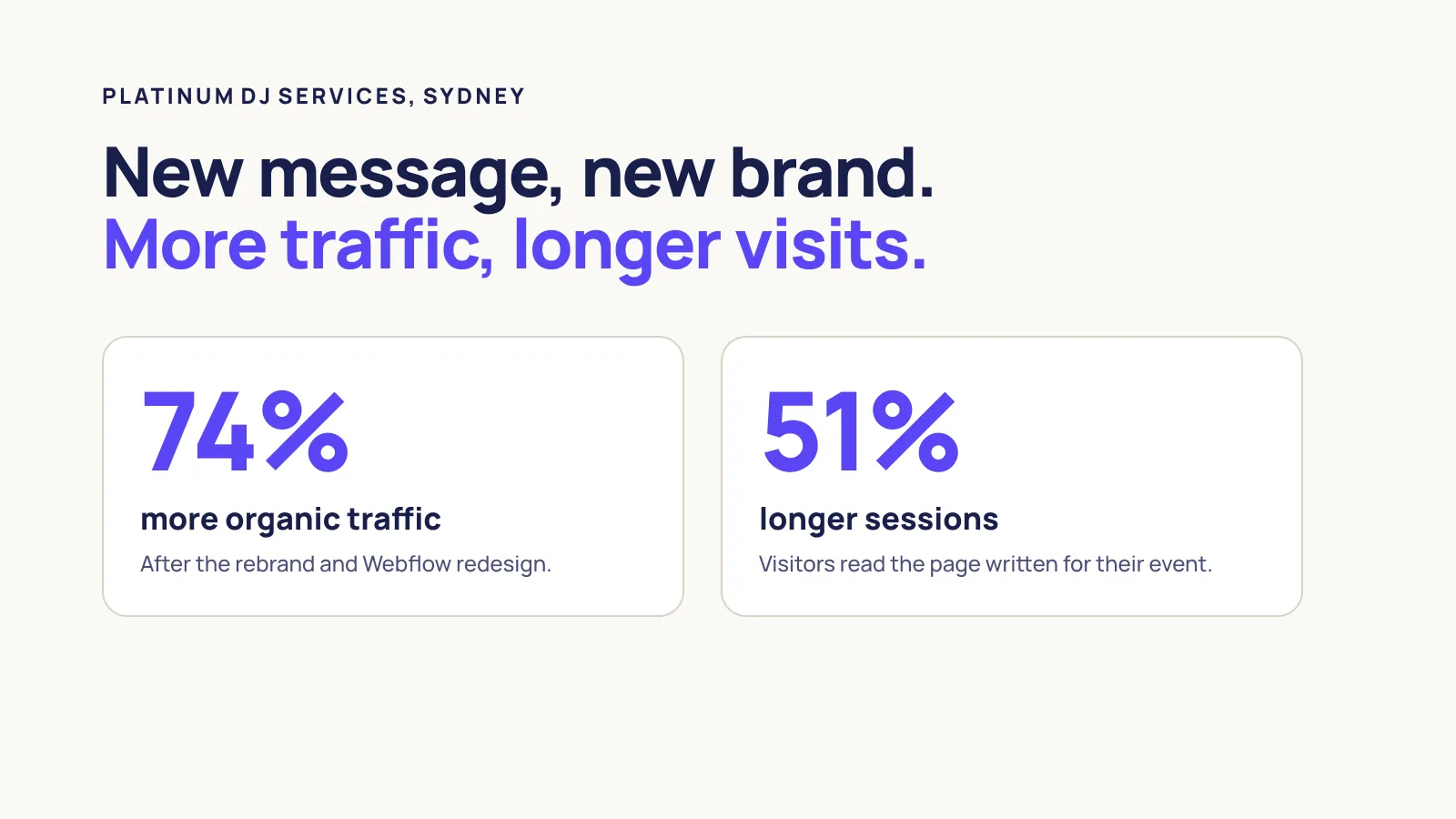
After launch, organic traffic rose 74% and the average session lasted 51% longer.
The longer sessions matter as much as the traffic. They suggest people were reading the pages written for their kind of event, rather than leaving a generic one.
A new theme would only have made the old message look nicer. Read the full Platinum DJ Services case study.
Where website redesigns go wrong
Most redesigns that disappoint don’t fail on design. They fail on what was thrown away in the process, or on decisions made before anyone looked at the data.
On the client side
The most expensive mistake is redesigning for looks when the problem is conversion. A fresh design on the same unclear message gets you a nicer site with the same enquiry rate.
The second is changing everything at once: new domain, new platform, new URLs, new copy and new branding in a single launch. If rankings drop, nobody can tell which change caused it. Google’s own site-move guidance recommends making big changes one after the other, not all at the same time, so launch in phases where you can.
The third is late content. A project quoted at eight weeks becomes twelve when the copy and photos arrive in week seven. If nobody on your team has time to write, budget for a copywriter from the start.
The fourth is deleting old pages because they look dated. An old blog post or service page can still be the one bringing in half your search traffic. Check Search Console before anything is cut, and redirect what you remove.
On the agency side
Skipping the redirect map is the big one. Every old address that ranks needs a permanent redirect to its closest new page, or the rankings it earned go with it. Ask to see the redirect map before the build starts, not after launch.
We learned how easily this slips on our own site. When we changed our URLs to end in a trailing slash, the redirects from our old addresses stopped working, and we only caught it because we tested every old URL in a preview build before going live.
The other agency mistakes are quieter. A template reskin gets sold as a redesign. A platform gets chosen because it’s the one the agency always uses. Analytics events and form tracking don’t get set up again on the new site, so for the first month nobody can tell whether it’s working.
Moving domains is the riskiest change of all
Changing your domain name is a different level of risk from redesigning on the same one. A Search Engine Journal study of 892 domain migrations (2025) found recovery took 523 days on average, and 17% of sites still hadn’t recovered after 1,000 days. Our position is simple. Keep your domain and your URLs unless there’s a strong business reason to change them.
How to decide what your website needs
Work through these in order before you ask anyone for a quote:
- Pull the last 12 months from Google Search Console and Google Analytics. List the pages that bring in traffic and the pages that bring in enquiries. Those pages need protecting whatever you decide.
- Write down what the site needs to do that it can’t do today, such as a new service line, a booking flow, campaign pages or a CMS your team can actually use.
- Run your key pages through PageSpeed Insights on mobile. If they fail Core Web Vitals, note whether the platform or the page is to blame.
- Match your answers to the four options above. If the site works and two pages don’t, fix the pages. If the platform is the problem, plan a rebuild.
- Get quotes against the same written scope, including the number of page templates, copywriting, integrations, the redirect map and what isn’t included.
- Pick a launch window away from your busiest season, and keep the redirects in place for at least a year.
Sometimes the answer is not to redesign at all. GeoSurv, a Sydney surveying firm, wanted to run Google Ads, but its old Wix site turned only 0.61% of ad clicks into form submissions. Instead of a redesign, we built five service landing pages beside the existing site, and in the first three months the form submission rate rose to 2.47%. See the GeoSurv case study.
For the questions to ask agencies before you sign, see our guide to 10 questions to ask website design services.
Plan for AI search while you’re redesigning
A redesign is the cheapest moment to make your site readable by AI tools like ChatGPT and Perplexity. Make sure page text sits in the HTML rather than loading through JavaScript. Vercel’s 2024 analysis found the major AI crawlers, including ChatGPT’s and Claude’s, don’t run JavaScript. Then add structured data for your business, services and FAQs. Doing it during the build costs less than retrofitting it later.
Before launch, view the new templates with JavaScript turned off. If the headings and copy disappear, AI crawlers won’t see them either.
FAQs
How long does a website redesign take?
Most of our website redesigns take around 6 to 8 weeks from the first call to launch, depending on scope. A few new landing pages can go live in 1 to 2 weeks. The usual cause of delays is content and approvals, not the build, so having copy and photos ready keeps the timeline on track.
Who owns the website after a redesign?
You should. Make sure the domain, hosting, CMS account, analytics and design files are registered to your business, and that the contract assigns the work and IP to your business. Check this before you sign, because changing it later is harder.
Should we rebrand before or after redesigning the website?
Do them together if a rebrand is already planned, so you only rebuild the site once. A new logo and colours are quick to apply during a redesign but costly to retrofit afterwards. If the rebrand is more than six months away, fix the pages that are losing enquiries now and redesign with the new brand later.
Next steps
- Ready to talk? Book a call with our team and we’ll tell you whether your site needs a fix, a refresh, a redesign or a rebuild. Contact Webhaus
- Comparing options? See how a rebrand and redesign lifted organic traffic 74% in the Platinum DJ Services case study, or read about our website design and development service.
- Still learning? Start with What is website development?, our plain-English guide to how websites are built.
Before you approve a website redesign, find out which pages bring in your enquiries today, and make sure every one of them survives the rebuild.