You’ve got three quotes for a new website: $6,000, $32,000 and $60,000. All three promise a fast, modern, SEO-friendly site. The gap between them comes from what each web design agency includes, assumes and leaves out, and most of that never makes it onto the quote. These ten questions draw it out, so you can compare website design services on what you’ll actually get, not on how the proposal reads.
Website design services cover planning, designing and building a business website: the page structure, copy, visual design, development, content management system (CMS) setup and launch. Most Australian web design agencies also offer SEO and ongoing maintenance. The price depends on the number of pages, the functionality and the integrations involved.
In this guide
- 10 questions to ask website design services
- Red flags in a web design agency’s answers
- How to compare website design quotes
- Freelancer, web design agency or website builder?
10 questions to ask website design services
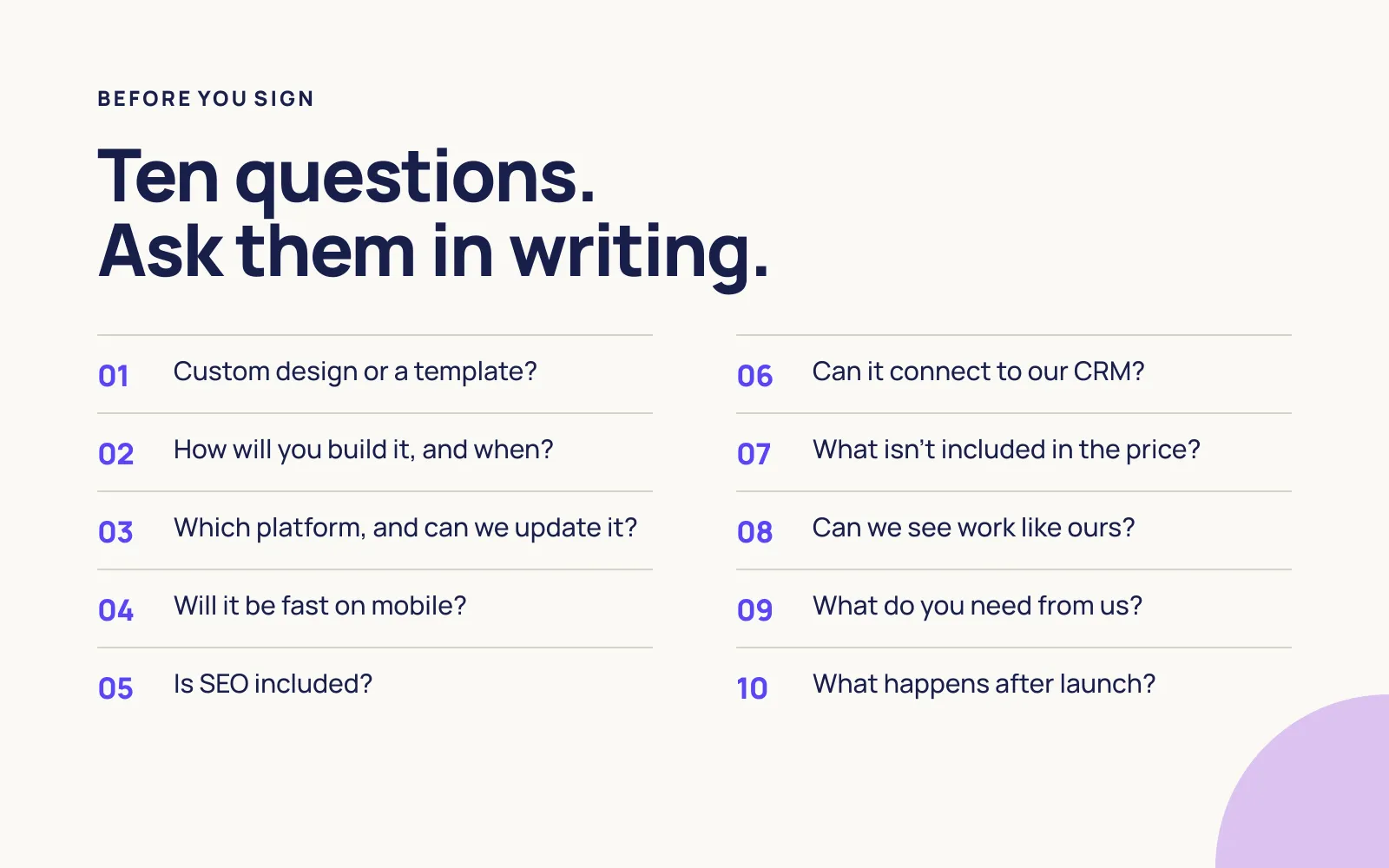
1. Will my website be custom designed, or built from a template?
A template is a ready-made layout that gets your logo, colours and words. A custom design starts from your business: your customers, your services and the action you want visitors to take. Both are legitimate. Templates are quicker and cheaper, and they suit a simple brochure site.
The catch is that a template decides your page structure for you. If your website is where enquiries come from, you want the structure built around how your buyers decide, not around a theme someone sold to thousands of other businesses.
A good answer: a clear recommendation for your business. That might be a template, a custom-coded build, or a mix of both, such as custom-designed pages built on a platform like Webflow or WordPress. Either way, they explain why it suits your goals and budget.
2. How will you build it, and how long will it take?
Ask them to walk you through their process, step by step. Most web design agencies work through discovery, sitemap, design, development, testing and launch, but the useful detail is in the specifics: how many design concepts you’ll see, how many rounds of changes are included, and when you sign off each stage.
Then ask for a timeline with dates. Small business sites typically take two to four weeks once content is ready, and custom builds six to twelve, according to the What’s The Damage? cost guide.
A good answer: a written plan with stages, sign-off points and the dates they depend on you for.
3. Which platform will you use, and can my team update the site?
WordPress, Webflow, Shopify and custom code each suit different businesses. The right one depends on who updates the site, whether you sell online and which tools it has to connect to. Be wary of a web designer who builds everything on one platform. That choice was made for their convenience, not your business.
Ask to see the content management system before you sign, and ask what training is included. When we rebuilt the site for Vonnimedia, a Sydney paid social agency, the brief included a Webflow CMS their team runs themselves, so new case studies go live the week a campaign finishes.
A good answer: a platform recommendation tied to how your team works, plus a CMS demo.
4. Will it work on mobile, and how fast will it load?
Every agency will say yes to mobile-friendly. Ask them to prove it. Google measures page experience with Core Web Vitals, and a good score means the main content loads within 2.5 seconds, the page responds to a tap within 200 milliseconds, and the layout shifts by less than 0.1.
Ask for a PageSpeed Insights report on the staging site, tested on mobile. Our own homepage scored 100 for performance in Lighthouse on mobile and desktop in October 2026, so it’s a fair thing to ask for.
A good answer: a speed target they’ll commit to, and a report before launch.
5. Is SEO included, and how will you protect our rankings?
“SEO included” can mean anything from page titles to a full search strategy. Ask what’s actually done: page titles and meta descriptions, headings, image alt text, structured data, a sitemap and Google Search Console setup.
If you’re replacing an existing site, ask about redirects. Every old URL needs to point to its new one, or the rankings you’ve built up can disappear in weeks. We learned how easily this slips on our own site. When we changed our URLs to end in a trailing slash, the redirects from our old addresses stopped working until we rewrote them. We caught it in a preview build because we tested every old URL before launch.
A good answer: a list of what’s included, and a redirect map for any rebuild. Ask whether they also offer ongoing SEO and AI search services if you’ll need more later.
6. Can it connect to our CRM and other tools?
A website rarely works alone. Enquiry forms should land in your CRM, bookings should sync with your calendar, and purchases should reach your accounting software. Name the tools you use, such as HubSpot, Salesforce, Mailchimp or Xero, and ask how each will connect.
Integrations are a common reason quotes differ, so make sure each agency has priced the same ones.
A good answer: each tool named in the proposal, with how it connects and what it costs.
7. What exactly does it cost, and what isn’t included?
Get the inclusions and the exclusions in writing: page templates, rounds of changes, copywriting, content migration, stock images, integrations, hosting, and whether the price includes GST. For reference, here’s what our projects cost.
| Project | What it involves | Webhaus price (ex GST) |
|---|---|---|
| Business website | 10–30 pages, CMS, forms, analytics | $25,000–$60,000 |
| Ecommerce store | Products, checkout, payments, stock and shipping | $30,000–$75,000 |
| Landing page | Single-purpose pages for campaigns and ads | $3,500–$7,500 for the first page, $1,500–$3,000 per variant |
| Web app or portal | Logins, user data and custom features | From $9,500 (tool) to $60,000+ (portal) |
| Rebuild or migration | Moving platforms while keeping rankings and URLs | Build price + $1,800–$4,500 for SEO migration |
A good answer: a fixed price with a written “not included” list. We’d trust a long exclusions list over a short quote every time.
8. Can we see websites you’ve built for businesses like ours?
A portfolio shows what a web design agency can design. Results show what its websites do. Ask for two or three examples in your industry or at your size, and ask what changed for each client after launch.
For example, when we rebuilt the website for Platinum DJ Services, a Sydney entertainment business, organic traffic grew by 74% and the average session lasted 51% longer within 12 months of launch. Then ask for a past client’s phone number, and call them.
A good answer: live websites you can click through, with at least one result and one client you can speak to.
9. What do you need from us, and who will we deal with?
Projects stall on the client side more often than people expect, usually waiting on copy, photos or sign-off. Ask exactly what you’ll need to supply and when: logins, brand files, photos, copy, and feedback deadlines. Ask whether copywriting is included, because writing a whole site yourself is a bigger job than it looks.
Then ask who you’ll talk to. The person who sells the project is often not the one who builds it. You want one day-to-day contact, a clear way to reach them, and to know whether the team is in Australia.
A good answer: a list of what they need from you with dates, and a named contact.
10. What support do you provide after launch, and who owns the site?
A website needs updates, backups and security patches every month. Plugins are the usual weak point: Patchstack’s 2026 report found 91% of new WordPress vulnerabilities in 2025 were in plugins. Ask what a monthly plan covers and whether it includes time for changes. Our website maintenance plans start from $550 a month.
Ownership matters just as much. The domain, hosting, Google Analytics, Search Console, the CMS account and the design files should all be in your business’s name. Ask what happens if you part ways.
A good answer: a clear monthly plan, and everything registered to you.
Red flags in a web design agency’s answers
Some answers sound reassuring and tell you very little. Here’s what to listen for.
| What the agency says | What it usually means |
|---|---|
| “SEO is included.” | Page titles and a sitemap. Ask what else, specifically. |
| “Unlimited revisions.” | No clear scope, so changes turn into delays instead of costs. |
| “We’ll host it for you.” | Check whose name the hosting account is in. |
| “It’ll be mobile-friendly.” | Ask for the mobile PageSpeed score, not the promise. |
| “We’ll sort the content later.” | Your launch date depends on copy nobody has written. |
| A quote with no exclusions | The exclusions exist. You’ll meet them halfway through. |
The cheapest quote isn’t automatically wrong. If your website is a brochure that rarely changes, a simple template site is a fair choice. If the website is where your enquiries come from, budget for custom work, because speed, tracking and how the CMS is set up are the decisions a template tier doesn’t cover.
Red flags run both ways. Agencies notice when a client has no single person who can sign off, or wants to add an online store halfway through a brochure site. Both reset the timeline. Pick one decision-maker before you start, and save new ideas for a second stage after launch.
How to compare website design quotes
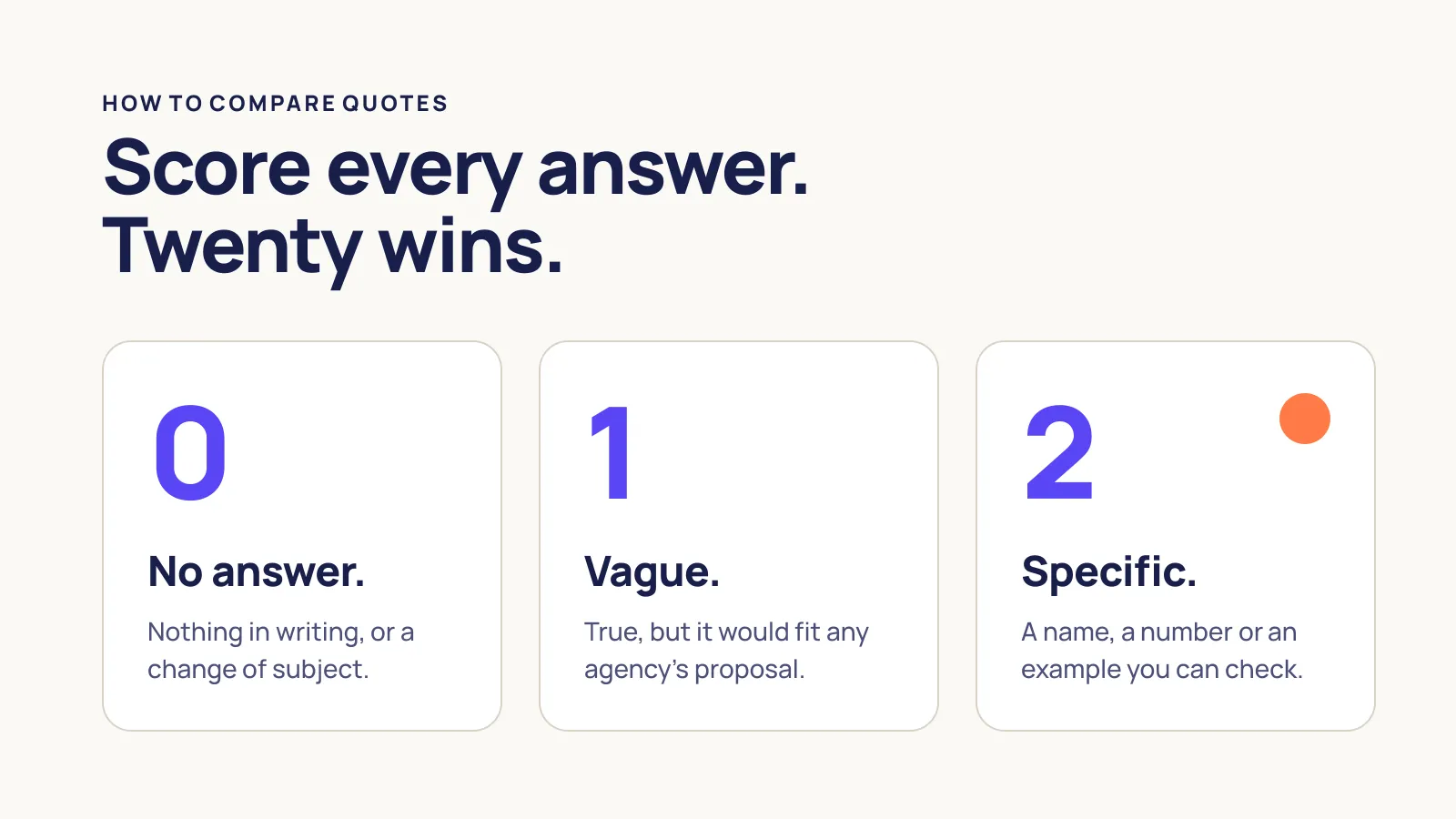
Send all ten questions to every web design agency on your shortlist and ask for the answers in writing. Then:
- Score each answer 0, 1 or 2. 0 for no answer, 1 for a vague one, 2 for a specific answer with a name, number or example. Twenty is a perfect score.
- Line up the inclusions. Make sure each quote covers the same templates, copy and integrations before you compare prices.
- Add the exclusions. Price anything left out that you’ll need anyway, such as copywriting or the first year of hosting.
- Test their own website. Run it through PageSpeed Insights on mobile. A web design agency’s own site shows the standard it works to.
- Call one past client. Ask what ran over, how the agency handled it, and whether they’d hire them again.
- Add the aftercare. A cheap build with an expensive care plan can cost more over two years than the other way round.
The agency with the highest score usually isn’t the cheapest. But you’ll know exactly what the difference buys you.
Freelancer, web design agency or website builder?
A website builder like Wix or Squarespace suits a sole trader who needs a few pages and is happy to maintain them. A freelancer suits a small site with a clear brief and a set budget. A web design agency makes sense when the website has to bring in enquiries, connect to your other tools and be looked after once it’s live, because you’re buying a team that’s still around after launch.
FAQs
What is website design?
Website design is planning how a website looks and works: the page layout, colours, typography, images and the path a visitor takes towards an enquiry or a sale. It sits alongside website development, which turns the design into a working site. Good website design starts from the business goal and the people using the site, not from a template.
What are the 7 C’s of website design?
The 7 C’s come from Jeffrey Rayport and Bernard Jaworski’s framework for how a website serves its users: context, content, community, customisation, communication, connection and commerce. Context covers layout and visual design, and connection covers links to and from other sites. Most business websites don’t need all seven equally. For a service business, context, content and communication do most of the work.
What are the 5 elements of a good website design?
There’s no official list, but these are the five we check on every site: a clear structure and navigation, content that answers your buyers’ questions, a visual hierarchy that matches your brand, fast loading on mobile, and an obvious next step on every page. A site that gets these five right will do more for you than one with extra features and none of the basics.
How many website design quotes should I get?
Three is enough for most businesses. Fewer than three gives you nothing to compare against, and more than four turns into a full-time job. Shortlist on portfolio and reviews first, then send the ten questions to your final three.
What should I prepare before contacting a web design agency?
Have your main goal, two or three websites you like (and why), your rough budget and your deadline. If you have a current site, have the logins for your domain, hosting, Google Analytics and Search Console ready. Agencies can quote faster and more accurately with these in hand.
Next steps
Webhaus is a Sydney web development agency that designs and builds websites for businesses and marketing teams across Australia, at a fixed scope and a fixed price.
- Ready to talk? Fill in our contact form and we’ll answer all ten questions about your project.
- Still learning? Read What Is Website Development? A Guide for Marketers.
If you only ask website design services one question, make it what isn’t included in the price. The answer tells you more about a web design agency than its portfolio does.