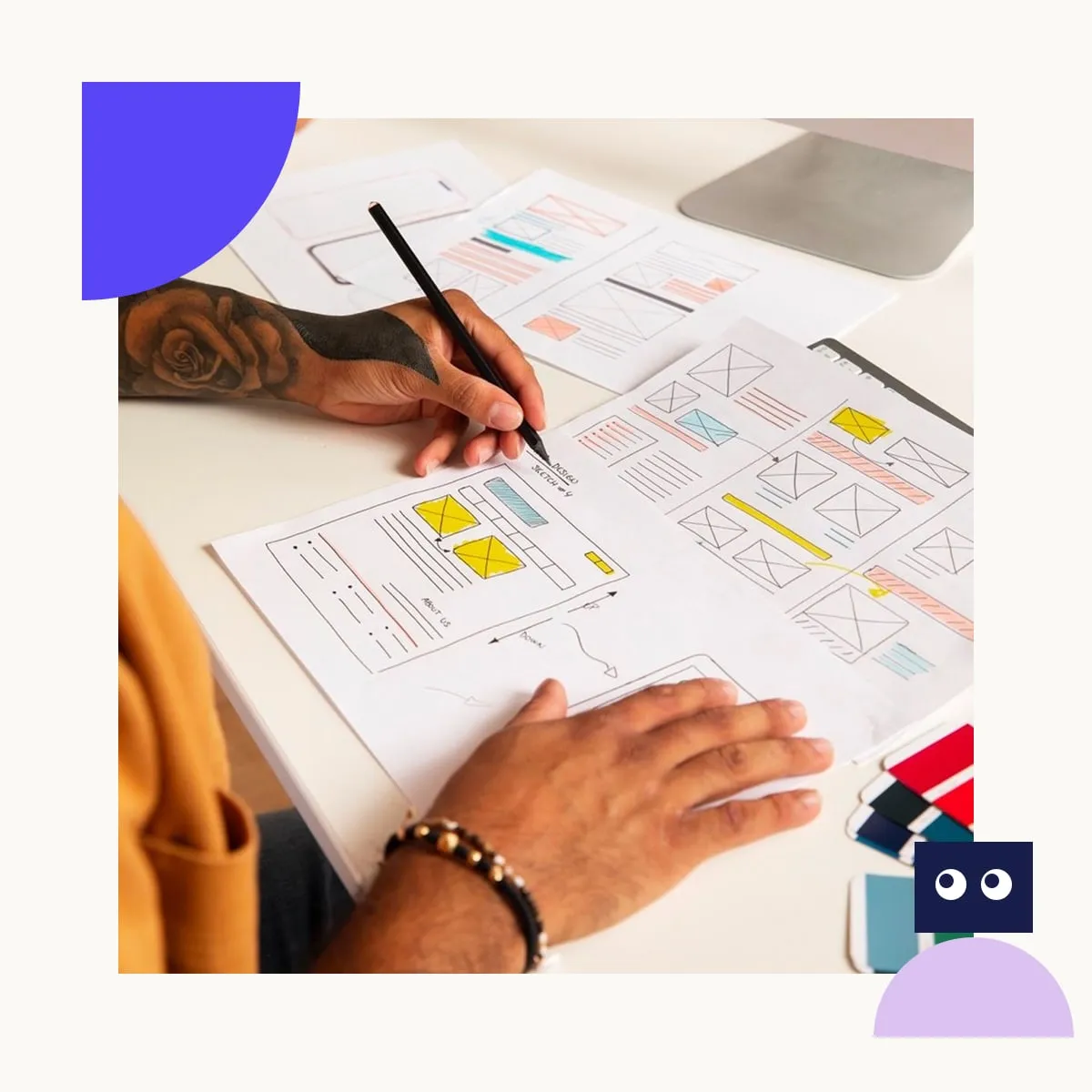
Most businesses judge a website by how it looks. Google, ad platforms and customers judge it by how it works. A slow mobile page wastes clicks you’ve already paid for, and a form that quietly stops sending loses leads you’ll never hear about. This guide answers “what is web development?” in plain terms. It covers how a website gets built from the first brief to launch, and why the technical side shapes the numbers your marketing team reports on every month.
In this guide
- What is web development?
- The website development process, step by step
- Why website development matters for marketing
- What a web development agency does
- Web development terms worth knowing
What is web development?
Web development is the work of building and maintaining websites and web applications. It covers the front end people see in their browser, the back end that stores data and runs features, and the content management system (CMS) a business uses to update pages. It turns a design into a working, fast and secure website.
“Website development” and “web development” mean the same thing in most conversations. Web development is the broader term, because it also includes web apps, customer portals and online tools that aren’t websites in the usual sense.
Front end, back end and the CMS
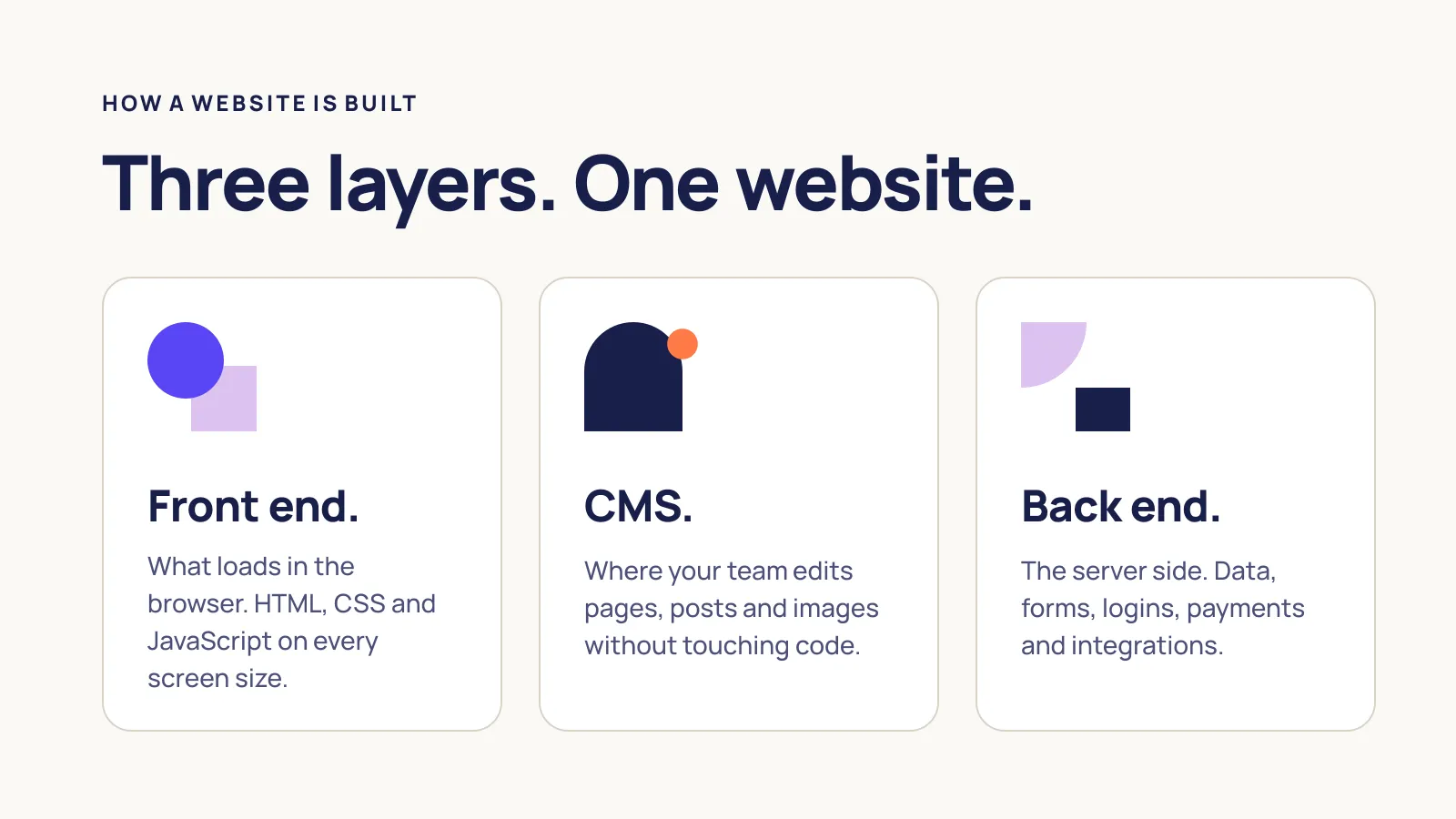
The front end is everything that loads in a visitor’s browser. HTML gives a page its structure, CSS controls how it looks, and JavaScript handles anything interactive, like a menu that opens or a calculator that updates as you type. Front-end work also covers making every page behave on phones, tablets and wide screens.
The back end runs on a server, out of sight. It stores data, processes forms, handles logins, takes payments and passes leads into tools like HubSpot or Salesforce. A brochure site might barely have one. An online store or booking system depends on it.
The CMS sits between the two. It’s the dashboard where your team edits pages, publishes blog posts and swaps images without touching code. WordPress, Webflow and Shopify are the names most Australian businesses will know. A headless CMS stores content separately and feeds it into a custom-coded front end.
Developers usually specialise. Front-end developers build what people see, back-end developers build what runs behind it, and full-stack developers work across both.
Web design vs web development
| Web design | Web development | |
|---|---|---|
| Focus | How the site looks and how people move through it | How the site works, loads and connects to other tools |
| Output | Wireframes, mockups, a style guide | A live website, a CMS, working forms and integrations |
| Typical tools | Figma, brand guidelines | Code editors, frameworks, hosting, the CMS itself |
| You notice it when | The site feels trustworthy and easy to use | Pages load fast, forms arrive and rankings hold |
Design and development overlap more than this table suggests. A design that ignores how it’ll be built usually turns into a slow, hard-to-edit site, which is why the two teams should work together from the first week. It’s also why our website design and development service keeps both in one team.
Types of website development projects
| Project | What it involves | Webhaus price (ex GST) |
|---|---|---|
| Business website | 10–30 pages, CMS, forms, analytics | $25,000–$60,000 |
| Ecommerce store | Products, checkout, payments, stock and shipping | $30,000–$75,000 |
| Landing page | Single-purpose pages for campaigns and ads | $3,500–$7,500 for the first page, $1,500–$3,000 per variant |
| Web app or portal | Logins, user data and custom features | From $9,500 (tool) to $60,000+ (portal) |
| Rebuild or migration | Moving platforms while keeping rankings and URLs | Build price + $1,800–$4,500 for SEO migration |
Web apps sit at the custom end. They’re built around a specific workflow, such as a client portal or an internal quoting tool, rather than a set of pages.
What changes the cost and timeline
Five things move the price more than anything else:
- the number of unique page templates
- integrations with a CRM, booking system, payment gateway or ERP
- whether copywriting and content migration are included
- the platform, since custom code and off-the-shelf themes are priced very differently
- any custom functionality, like calculators, filters or member areas.
Content is the most common cause of delays. Builds rarely run late because of code. They run late because pages are waiting on copy, photos or sign-off.
The website development process, step by step
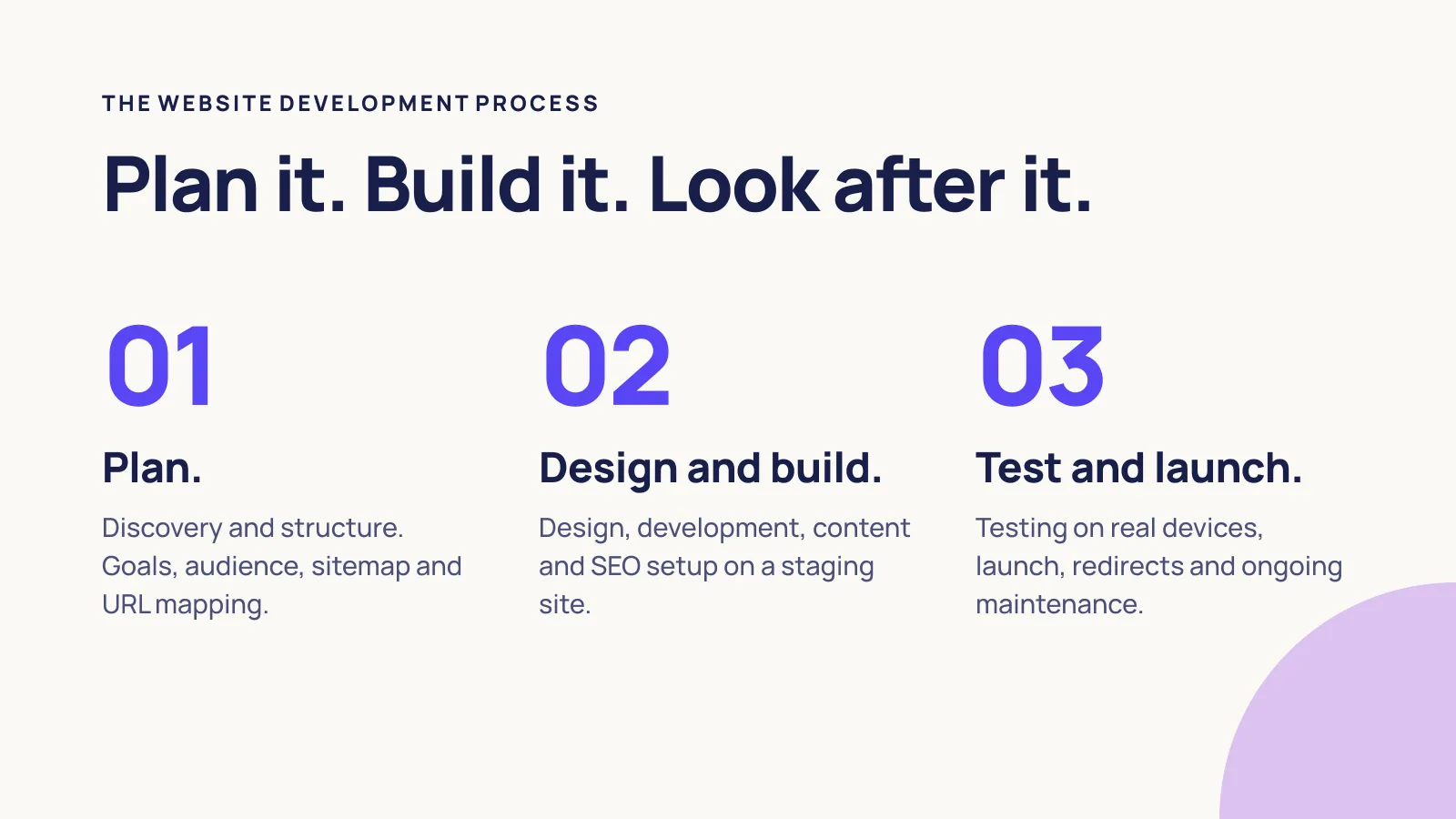
Agencies name the stages differently, but most website projects follow the same order. Skipping or rushing one usually shows up later as a delay or a fix after launch.
Planning
-
Discovery. The team agrees on what the site has to achieve, who it’s for and what a successful visit looks like, such as an enquiry, a booking or a sale. Existing analytics and rankings get reviewed here, along with competitor sites and the tools the website has to connect to.
-
Structure. A sitemap sets out every page and how they connect. For a rebuild, this is where old URLs are mapped to new ones so search rankings carry over. It’s also where you decide which pages need their own template and which can share one.
Design and build
-
Design. Wireframes set the layout of key pages first. The visual design follows, usually as a small system of reusable sections rather than one-off pages. A system like this is what lets your team add new pages later without them looking out of place.
-
Development. Developers build the pages, set up the CMS, and connect forms, analytics and other tools. Work happens on a staging site, a private copy that clients can review before anything goes public.
-
Content and SEO setup. Copy and images go in. Each page gets a title, meta description, headings, image alt text and structured data. Redirects are added for any URL that’s changing.
Testing, launch and beyond
-
Testing. The site is checked on real phones and browsers, along with page speed, forms, broken links and accessibility. This step is where most launch problems should be caught.
-
Launch. The domain is pointed at the new site, the redirects go live, and the sitemap is submitted to Google Search Console. The first few days are spent watching for errors and missed redirects.
-
Maintenance. A site needs updates, backups, security patches and speed checks after launch. Without website maintenance, small issues pile up quietly until a rebuild looks like the only fix.
Why website development matters for marketing
Every campaign ends up on a web page. How that page was built decides how much of your spend turns into results.
Speed affects rankings and conversions
Google measures page experience with three Core Web Vitals. A good score means the largest element loads within 2.5 seconds, the page responds to a tap within 200 milliseconds, and the layout shifts by less than 0.1. These numbers come almost entirely from development decisions, like image sizes, the scripts a page loads and how the server delivers it.
The link to revenue is well documented. When Vodafone improved its largest contentful paint by 31%, it recorded 8% more sales and a 15% better lead-to-visit rate. Our view is that a fast, plain page will beat a slow, beautiful one in almost any ad account.
Search engines and AI tools have to read the page
Google, ChatGPT and Perplexity can only cite what they can read. Pages that rely on JavaScript to show their main text are harder to crawl. Vercel’s analysis of AI crawler traffic found that none of the major AI crawlers, including those from OpenAI, Anthropic and Perplexity, run JavaScript. Google is the exception. Clean headings, server-rendered content and structured data (schema) all come from the build, so they’re development work. Our guide to what SEO services are covers the rest of the work that gets a site found.
The structure of the page matters too. AI answers tend to quote short definitions, lists and tables that make sense out of context. A developer can’t write that content, but they decide whether the template gives it a clear place to sit, with proper headings and FAQ markup.
Tracking you can trust
Conversion tracking is only as good as its setup. Developers connect form submissions, phone clicks and purchases to Google Analytics, ad pixels and the CRM. When that’s done badly, campaigns get judged on the wrong numbers, and budgets shift to the wrong channels.
Security and trust
Chrome marks every site without HTTPS as “Not secure”. Plugins are the bigger risk for most small businesses. Patchstack’s 2026 report found that 91% of new WordPress vulnerabilities in 2025 were in plugins, and 46% weren’t fixed by the time they were made public. A hacked site can be flagged in Google’s results or blocked by browsers entirely. Keeping the site secure is development work that never really finishes.
Your team’s independence
A well-built CMS lets marketing publish a landing page on the same day a campaign is approved. A poorly built one turns every headline change into a ticket. We’d argue this is the most underrated outcome of website development, because it decides how fast your marketing can move for years after launch.
What a web development agency does
A web development agency plans, builds and looks after websites for other businesses. Some only build to someone else’s design. Others handle strategy, copy, design, development, SEO and maintenance under one roof.
The other options are a freelancer or an in-house developer. A freelancer can suit a small site with a clear brief. An in-house developer makes sense once a business needs changes every week. An agency fits in between, when a project needs several skills at once and a team that’s still around after launch.
Use this checklist when you’re comparing agencies:
- They ask about goals before pages. A good first meeting covers who the site is for and what counts as a result.
- They recommend a platform for your team, not for themselves. Ask who will update the site day to day and how.
- The scope is written down. Check the page templates, integrations, content and rounds of changes it includes.
- They have a plan for your rankings. For a rebuild, ask to see how old URLs will be redirected.
- You own everything. The domain, hosting, code and accounts should all sit in your business’s name.
- There’s testing before launch. Ask what they check, and on which devices.
- They explain what happens after launch. Ask who handles updates, security and the next round of changes.
- Their own site is fast. Run it through PageSpeed Insights before the first call.
An agency that can answer all eight clearly is usually one that has done this many times before. For a fuller list, with what a good answer sounds like, see our 10 questions to ask website design services.
Web development terms worth knowing
- Staging site. A private copy of the website used for building and reviewing changes.
- Hosting. The server space where your website’s files live.
- DNS. The settings that point your domain name at your hosting.
- Headless CMS. A CMS that stores content separately from the design, so a developer can display it anywhere.
- 301 redirect. A permanent forward from an old URL to a new one, which passes most search value across.
- Schema. Code that labels a page’s content, such as a business address or an FAQ, so search engines and AI tools can understand it.
- Responsive design. A layout that adjusts to any screen size.
FAQs
What is the difference between web design and web development?
Web design decides how a website looks and how visitors move through it. Web development builds it, which includes the code, CMS, hosting, forms and integrations. Most projects need both, and they work best when the designer and developer plan pages together.
What does a web development agency do?
A web development agency builds and maintains websites for other businesses. Depending on the agency, that can include strategy, design, copy, SEO, integrations and ongoing support. Some also build web apps and customer portals.
How long does it take to develop a website?
A small business website usually takes two to four weeks once the content is ready, and a custom build takes six to twelve weeks. Ecommerce stores and web apps take longer. Delays usually come from content and approvals rather than the build.
Do you need to know how to code to run a website?
No. A CMS like WordPress, Webflow or Shopify lets you edit text, images and blog posts without code. You’ll still want a developer for new page templates, integrations and changes to how the site works.
Next steps
Webhaus is a Sydney web development agency that builds websites for businesses and marketing teams across Australia, at a fixed scope and a fixed price.
- Ready to start? Book a call and we’ll scope your project.
The best time to fix how a website is built is before the next campaign goes live. If yours is slowing your marketing down, talk to our team.