You search for a web development company and get a list of Sydney agencies, a “top 50” directory and a few offshore dev shops. Every one of them says it builds websites, and then the quotes arrive with one ten times the price of another for what reads like the same brief. That gap exists because at least five different kinds of business use the same name. This guide shows how to tell them apart, what each costs in Australia, and what goes wrong when you pick the wrong one.
What is a web development company? A web development company is a business that builds and maintains websites and web applications for other organisations. The work covers planning, front-end and back-end development, the content management system (CMS), integrations, testing, launch and ongoing support. Some also handle strategy, copywriting, design and SEO; others only build to someone else’s design.
In this guide
- The five kinds of web development company in Australia
- A real example: four times the form submissions without a rebuild
- Where it goes wrong, on both sides
- How to choose a web development company
- Web development company, web design agency or digital agency?
The five kinds of web development company in Australia
“Web development company” is a description, not a licence. A one-person business and a 40-person web development agency can both use it, and both can be the right choice for different jobs. The useful question is which kind you’re talking to, because that decides who writes your copy, which platform you end up on and who you call when a form stops working.
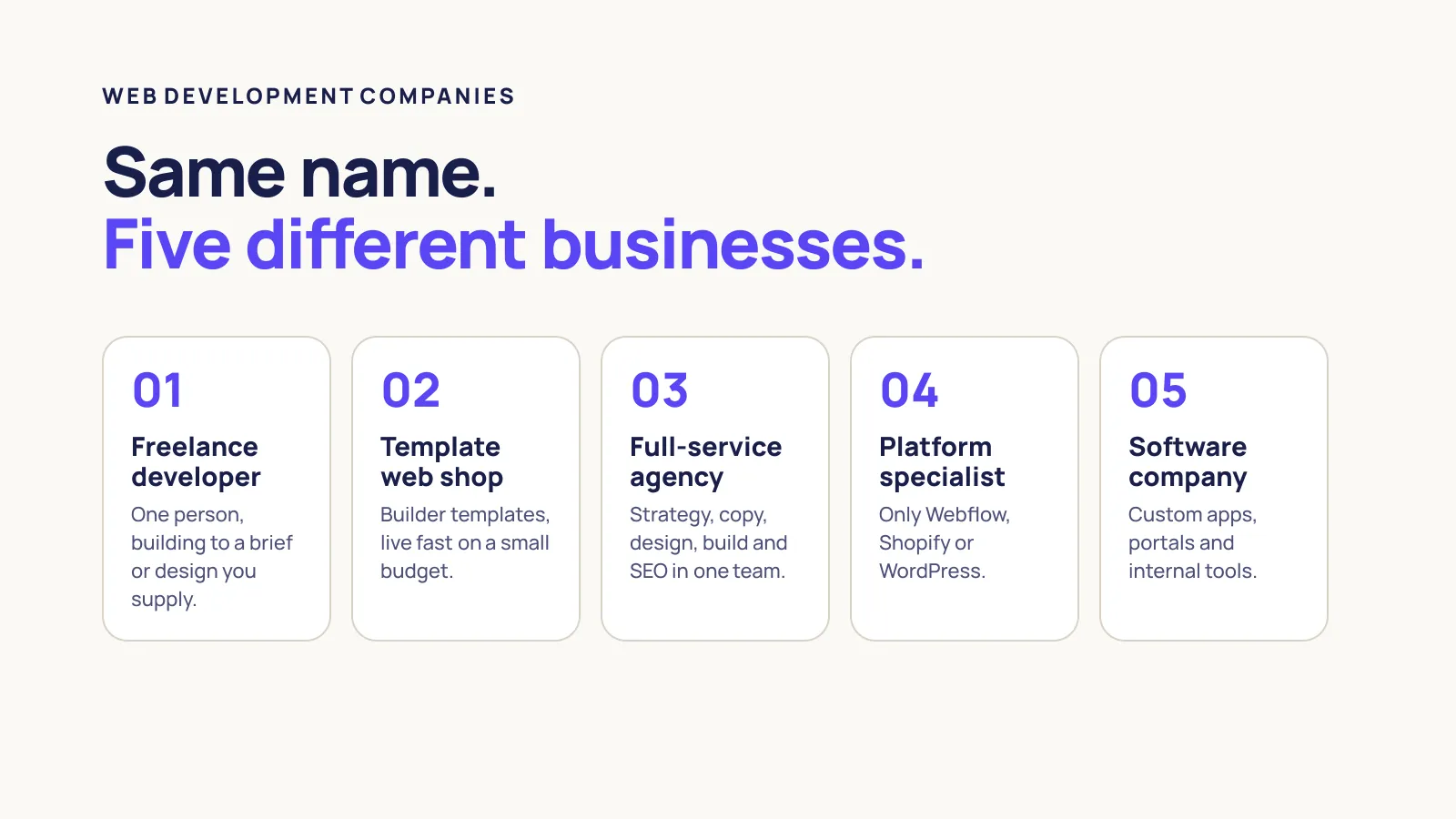
| Type | Who does the work | Best for | Watch for |
|---|---|---|---|
| Freelance developer | One person, often building to a design you supply | Small sites, fixes and add-ons with a clear brief | Holidays, illness and what happens when they move on |
| Template or package web shop | A small team working from templates on builders like Wix or Squarespace | Getting a simple site live quickly on a small budget | Lock-in: a Wix site has to stay on Wix’s servers, so outgrowing it means a rebuild |
| Full-service web development agency | Strategy, copy, design, development and SEO in one team | Business websites that need to bring in enquiries | Higher upfront cost, and whether the person you meet is the one who builds |
| Platform specialist | An agency that only builds on Webflow, Shopify or WordPress | When you’ve already settled on the platform | A recommendation shaped by the one platform they sell |
| Software or app development company | Engineers who build custom applications | Portals, booking systems, quoting tools, internal software | Too slow and expensive for a marketing website your team needs to edit weekly |
In our experience, most Australian small and medium businesses looking for a new website are choosing between the second and third rows. The fourth row matters when the platform is already decided, and the fifth only when the “website” is really an application with logins and user data.
What a web development company delivers
On a full project, a website development company should cover discovery (goals, audience, what’s broken now), page structure and copy, design, the build itself and a CMS your team can edit. After that come integrations such as HubSpot forms or a Shopify store connected to Xero, testing on real phones, and a launch with redirects from every old URL. Training and someone to call afterwards should be part of it too.
The parts we most often see left out of a quote are copywriting, SEO migration, hosting and photography. Studio Slate, a Sydney studio, puts it bluntly: copywriting is the first thing cheap builds skip. If a quote doesn’t name an item, assume it isn’t included and ask.
What a web development company costs in Australia
Prices for web development services swing because the five types above sell different amounts of work. As a reference point, here’s what we charge as a full-service agency at Webhaus, at fixed prices for a written scope:
| Project | What it usually includes | Webhaus price (ex GST) |
|---|---|---|
| Business website | 10–30 pages, CMS, forms, analytics | $25,000–$60,000 |
| Ecommerce store | Products, checkout, payments, stock and shipping | $30,000–$75,000 |
| Landing page | One page for a campaign or ad group | $3,500–$7,500 for the first page, $1,500–$3,000 per variant |
| Web app or portal | Logins, user data and custom features | From $9,500 (tool) to $60,000+ (portal) |
| Rebuild or migration | Moving platforms while keeping rankings and URLs | Build price + $1,800–$4,500 for SEO migration |
Hosting, updates and support are a monthly cost on top, from $550 a month on our care plans. Whoever you hire, get one fixed price for a written scope rather than an hourly estimate that grows with every round of feedback.
How long it takes
Our website projects take around 6 to 8 weeks, depending on scope, and a landing page goes live in 1 to 2 weeks from the first conversation. The build is rarely what slows a project down. Late copy, photos and approvals are.
A real example: four times the form submissions without a rebuild
GeoSurv is a surveying and utility locating firm in Kogarah, in Sydney’s south. They wanted to start running Google Ads, but the ads were pointing at a legacy Wix site that hadn’t been touched in years. Small edits took too long, the pages were slow, and only 0.61% of ad clicks turned into a form submission.
The obvious answer was a new website. We didn’t build one. A full rebuild would have delayed the advertising by months, and the problem was narrower than the whole site: paid traffic was landing on pages that weren’t made for it.
Instead we built five landing pages on a separate domain, geosurv.au, one for each core service: utility locating, sucker trucks, non-destructive digging, hydro excavation and vac trucks. Each page does one job for one service, with the copy matched to the ads sending people there. Every form submission and phone click is tracked back to the campaign, and we worked alongside GeoSurv’s advertising agency so the pages and ads could be improved together. The old Wix site stayed exactly where it was.
The results
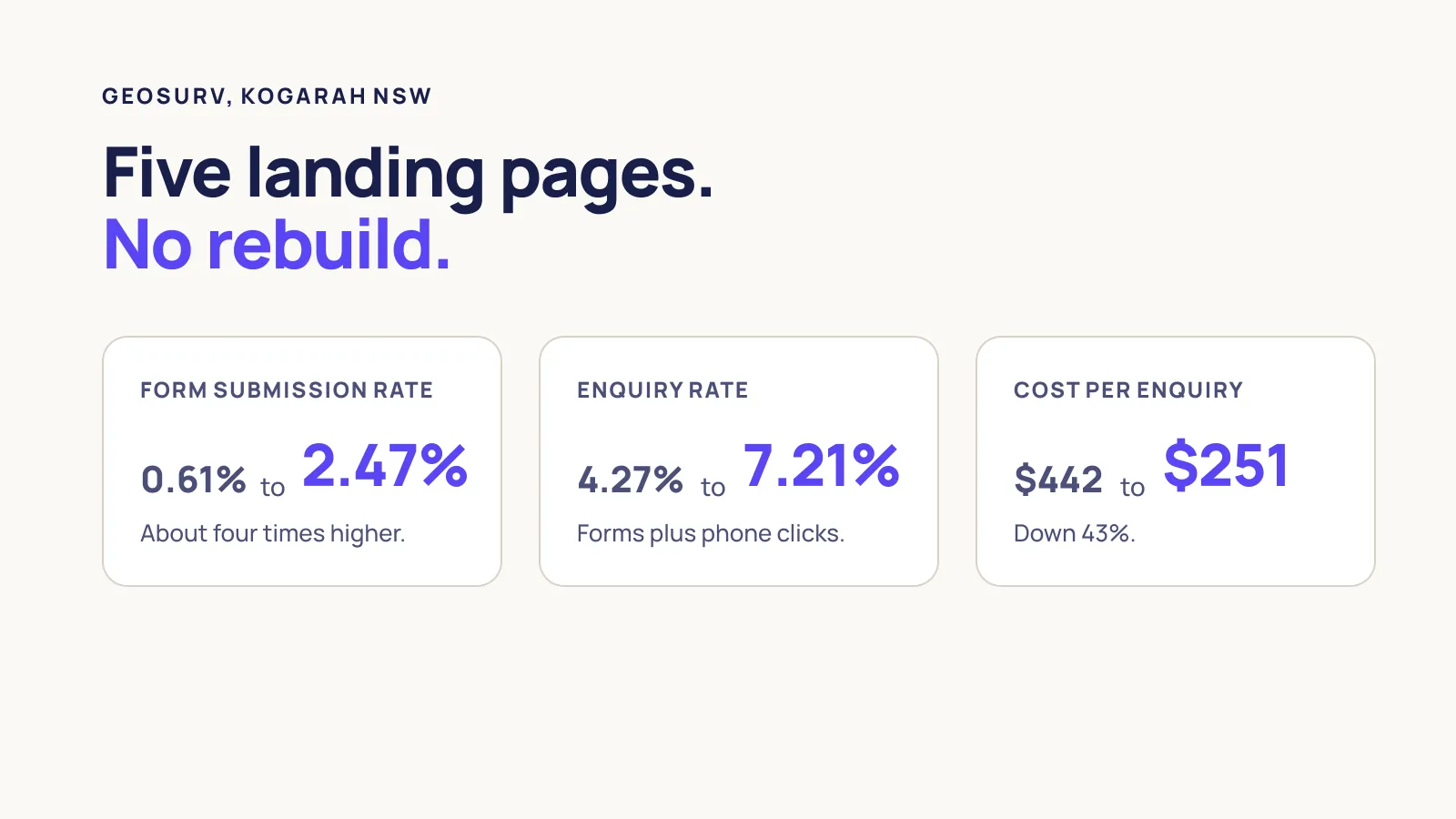
The pages went live on 29 June. Comparing the old site’s last 25 days with the new pages’ first three months:
- The form submission rate rose from 0.61% to 2.47%, about four times higher.
- The enquiry rate, counting forms and phone clicks, rose from 4.27% to 7.21%.
- The cost per website enquiry fell from $442 to $251, down 43%.
- Search impression share rose from 29% to 49%, at a slightly lower cost per click.
The two strongest pages, utility locating and sucker trucks, convert at 21.7% and 17.8%, at about $94 and $90 a lead. With call tracking added in July, the campaigns have produced 140 leads at $131 each since launch. The old site’s baseline was short, so treat the multipliers as directional rather than exact.
The lesson for anyone hiring a web development company: the right one will sometimes tell you that you don’t need a new website yet. A quote for a full rebuild is easy to write. Working out the smallest change that fixes the problem is the harder, more useful job. See the full GeoSurv case study.
Where it goes wrong, on both sides
The website projects we’re asked to rescue rarely fail on code. They fail on scope and ownership: what was meant to be included, and who controls the site once it’s live. We’d put ownership first, because a scope problem costs you money once and an ownership problem keeps costing you.
Mistakes we see from clients
Choosing on the total price without reading the exclusions is the big one. A $6,000 quote that leaves out copy, SEO migration and hosting can end up costing far more than it first looks, once you’ve paid for those separately and fixed any rankings you lost.
The second is late content. A project quoted at six weeks becomes twelve when copy and photos arrive in week nine. If you can’t write the content yourself, budget for someone who can before the project starts.
The third is asking for a rebuild when the problem is a few pages. GeoSurv is the example above.
Mistakes we see from agencies
The first is recommending the platform they know rather than the one that suits your team. Ask who will update the site day to day, and listen for whether the answer changes the recommendation.
The second is keeping the domain, hosting or code in the agency’s name. IP Australia states that IP created by a contractor belongs to the contractor unless the contract says otherwise, and for .au domains, whoever is listed as the registrant holds the licence. Get ownership written into the agreement, and make sure the domain and accounts are registered to your business.
The third is skipping redirects on a rebuild. We learned how easily this slips on our own site. When we changed our URLs to end in a trailing slash, the redirects from the old addresses stopped working, and we only caught it because we tested every old URL in a preview build before launch.
The last is promising rankings. Google’s own guidance says no one can guarantee a #1 ranking, so treat a guarantee as a reason to keep looking.
How to choose a web development company
- Decide who will run the site after launch. Your team, the agency, or both. This decides the platform more than anything else.
- Ask for live examples on the platform they’re recommending, plus the name of a past client you can call.
- Get the exclusions in writing. Copywriting, SEO migration, hosting, training and photography are the usual gaps.
- Confirm the domain, hosting, accounts and code will be in your business’s name.
- If you’re replacing a site, ask to see the redirect plan for your old URLs before the build starts.
- Ask what happens after launch and what it costs each month.
- Test their own website in Google PageSpeed Insights. Google’s Core Web Vitals guidance wants the largest element on a page to load within 2.5 seconds; an agency whose own site misses that is unlikely to beat it on yours.
For the questions to ask in the first meeting and what a good answer sounds like, see our guide to questions to ask website design services.
Web development company, web design agency or digital agency?
The names overlap so much that they’re close to useless on their own: a web design agency may design in-house and send the build to a contractor. A digital agency may be strongest at ads and social, with websites as a side service. A web development company may build well but expect you to supply the design and copy. Ignore the label and ask one question in the first meeting: who will write, design and build my site, and are they on your team?
FAQs
Should I use an Australian web development company or an offshore one?
Offshore teams often charge less per hour, and some do excellent work. In our view the trade-offs are time zones, slower feedback rounds and less you can do if something goes wrong after launch. If you go offshore, keep the domain, hosting and code in your own name, and get the scope and exclusions in writing before anything starts.
Do I need a web development company, or can I use a website builder?
For a simple site that doesn’t need to generate much business, a builder like Wix or Squarespace can be enough, but budget your own time: Webfriend estimates a DIY site takes most people 20 to 40 hours to build properly. Bring in a web development company when the site has to bring in enquiries or sales, connect to other systems, or keep your rankings through a move from an old site.
Will a web development company write my website content?
Some don’t, and others charge separately for it. Ask whether copywriting is included and who will write it, because in our experience the copy is what makes a page convert, and content is one of the most common causes of delays. If the answer is “you supply it”, budget the time or a copywriter before the project starts.
Can a web development company take over a website someone else built?
Yes, usually without starting from scratch. A good one starts with an audit and admin access to the CMS, hosting, domain, analytics and Google Search Console, then makes changes on a staging copy so your live site isn’t touched until you approve. Builder sites are the exception: a Wix site has to stay on Wix’s servers, so changing company often means a rebuild.
Can my team update the website after a web development company builds it?
Yes, if it’s set up for that before the build. Agree which content your team will manage, such as blog posts, team members and case studies, and ask for training on each part. On Webflow, for example, a content editor can update copy and CMS items without being able to change the design.
Next steps
- Ready to talk? Book a call with our team and we’ll tell you which kind of web development company your project needs. Contact Webhaus
- Comparing options? See how five landing pages did the job without a full rebuild in the GeoSurv case study, or read about our website design and development service.
- Still learning? Start with What is website development?, our plain-English guide to how websites are built.
Pick the web development company that asks who will run your website after launch, because that one answer shapes the platform, the price and how long the site lasts.