
You’ve probably had the cold email. “We noticed your website isn’t ranking on page one”, followed by a monthly SEO package that promises everything and explains nothing. The trouble is that “SEO services” covers seven quite different jobs, and most packages bundle them without telling you which one your website actually needs. This guide breaks down each type of SEO service, what it involves, what it fixes and how to tell which ones are worth paying for.
SEO services are the work an agency or specialist does to make a website rank higher in search results and get cited in AI answers. They cover technical SEO, on-page SEO, SEO copywriting, content authority, link building, local SEO and AI search optimisation. Each one fixes a different reason a website isn’t being found.
In this guide
- What SEO services cover
- Technical SEO: making sure Google can find and read your site
- On-page SEO: matching each page to a search
- SEO copywriting: words that rank and convert
- Content authority: owning a topic, not one keyword
- Link building: earning trust from other websites
- Local SEO: showing up in Google Maps
- AI search: getting cited by ChatGPT and Google AI
- What SEO services cost and how long they take
- Where SEO services go wrong
- Which SEO services does your business need?
- SEO services vs Google Ads
What SEO services cover
Search engine optimisation is everything that helps a search engine find your website, understand what each page is about and trust it enough to show it to someone searching. Google explains the basics in its own SEO Starter Guide, and it’s a useful read before you talk to any agency.
In practice, the work splits into seven types. They overlap, but each one answers a different question about your website.
| Type of SEO service | The question it answers | What the work looks like |
|---|---|---|
| Technical SEO | Can Google crawl, read and index the site? | Site audits, speed fixes, redirects, sitemaps, structured data |
| On-page SEO | Does each page match what people search for? | Page titles, meta descriptions, headings, internal links |
| SEO copywriting | Does the copy rank and persuade? | Service page copy, blog posts, product descriptions |
| Content authority | Is the site the go-to source on its topic? | Content strategy, topic clusters, author credentials |
| Link building | Do other websites vouch for it? | Partnerships, industry directories, local news, unlinked mentions |
| Local SEO | Does it show up for searches near you? | Google Business Profile, reviews, local citations |
| AI search | Do ChatGPT, Perplexity and Google AI mention it? | Answer-first content, schema, brand mentions, AI tracking |
The order in that table matters. A website with a technical problem, such as pages Google can’t index, gets little from new content or links until that’s fixed. Local SEO matters most if customers search with a suburb or “near me”. And AI search builds on everything above it, because AI tools mostly draw on the same pages and signals that rank well in Google.
Most business websites need two or three of these at any one time. A good SEO agency should tell you which ones, and why, before it quotes.
Technical SEO: making sure Google can find and read your site
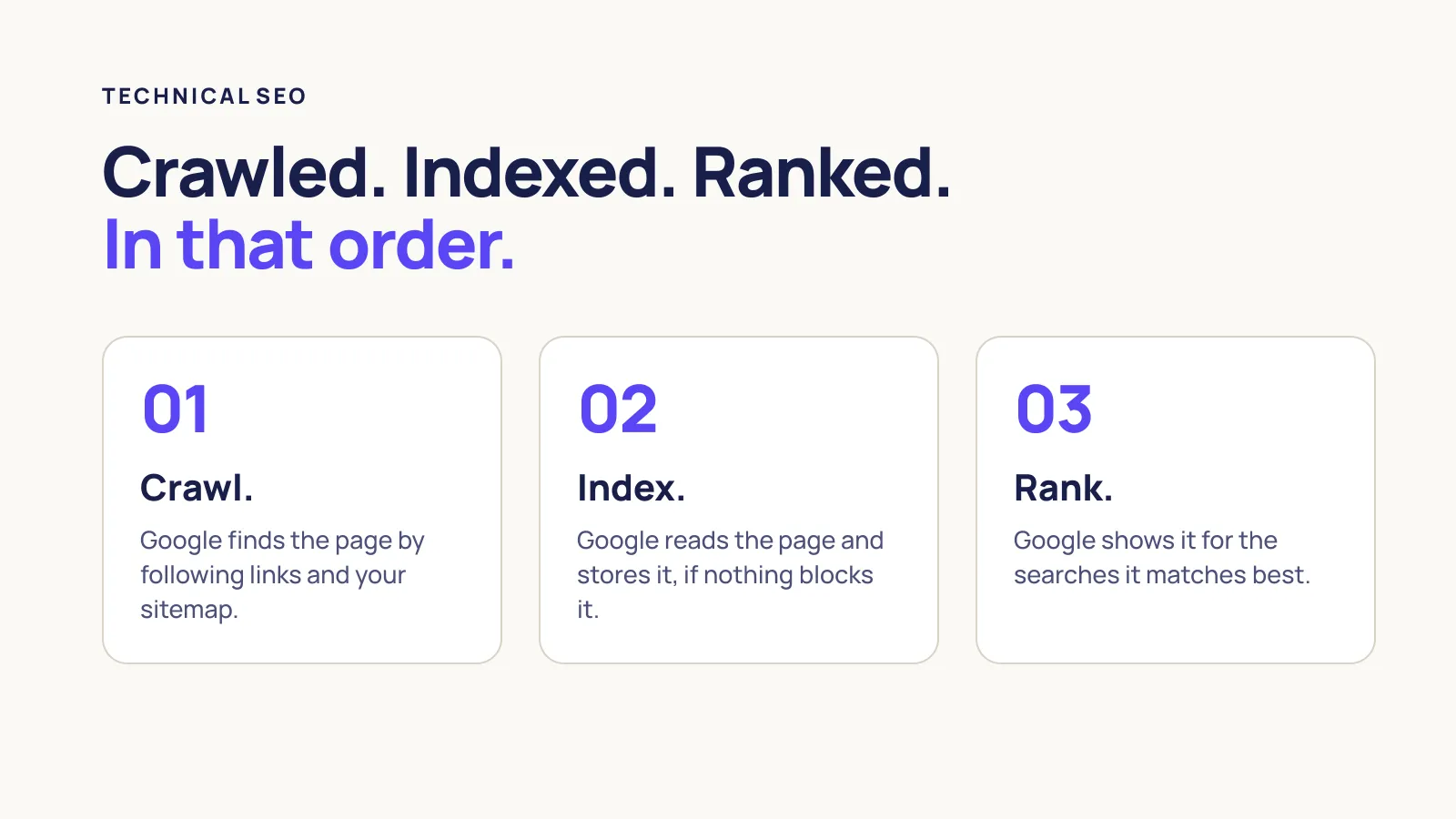
Technical SEO is the work behind the scenes that lets search engines crawl and index your website. Nobody sees it, and when it breaks, nothing else in SEO works properly.
What a technical SEO audit checks
A technical audit crawls every page the way Google does and flags what’s getting in the way. The usual checks:
- whether every important page can be indexed, and none are blocked by mistake
- broken links, redirect chains and pages returning errors
- duplicate pages and canonical tags that point Google to the right version
- page speed, measured by Google’s Core Web Vitals
- the XML sitemap and robots.txt file
- structured data (schema), which labels your business details, FAQs and articles
- mobile usability
Tools like Screaming Frog, Google Search Console and PageSpeed Insights do most of the finding. The value is in knowing which findings matter.
JavaScript is a hidden technical risk
Some websites only show their text after JavaScript runs in the browser. Google can usually handle that. Most AI tools can’t. Vercel’s analysis of AI crawler traffic found that none of the major AI crawlers, including OpenAI’s and Anthropic’s, run JavaScript at all. If your main content depends on it, AI search can’t read it. A quick test is to view your page source and check the text is there.
Technical SEO is where SEO and web development meet, which is why we fix these issues as part of our SEO services rather than handing over a list.
On-page SEO: matching each page to a search
On-page SEO makes each page clearly about one thing, so Google can match it to the right search. It’s the most direct lever you have over how a page appears in results.
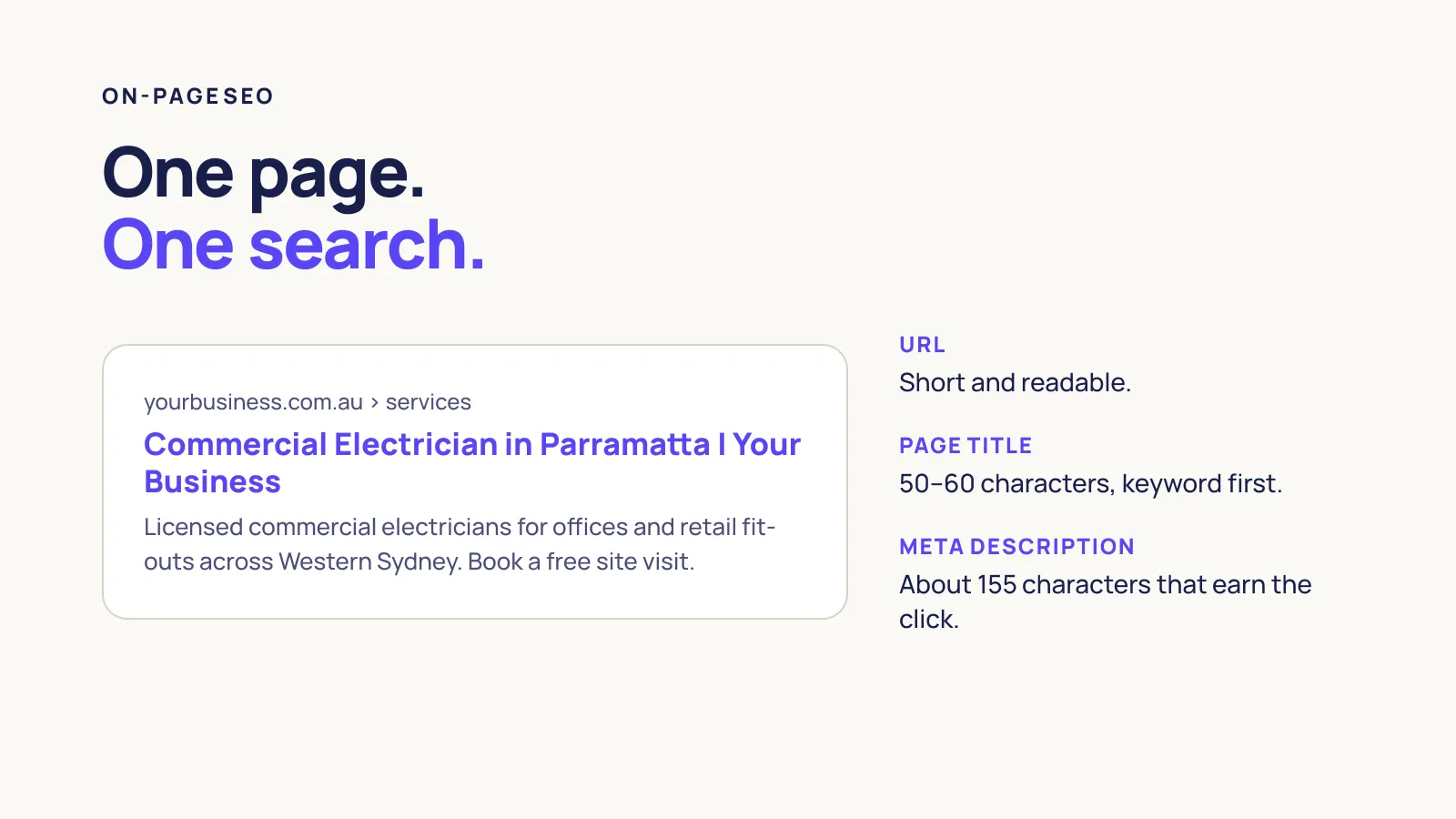
The elements on-page SEO covers
- Page title. The blue headline in Google. Around 50–60 characters, with the main keyword near the front.
- Meta description. The grey text under the title. It doesn’t affect rankings directly, but it decides whether people click.
- Headings. One H1 that says what the page is, then H2s and H3s that break it into sections people (and AI tools) can scan.
- Internal links. Links between your own pages, with anchor text that describes where they go.
- Images. Descriptive file names and alt text.
- URL. Short and readable, such as /services/seo/ rather than /page?id=482.
Search intent matters more than keywords
The most common on-page mistake is a page that targets a keyword without matching what the searcher wants. Someone searching “SEO services Sydney” wants to compare providers. Someone searching “what are SEO services” wants to understand the topic first. A sales page won’t rank for the second search, however many times it repeats the phrase.
One page per service helps here. When we rebuilt the website for Vonnimedia, a Sydney paid social agency, each service (paid social, SEO, SEM and performance media) got its own page, so each one could match its own search instead of four services competing on one page.
Google rewrites what it wants to
Google decides for itself what to show. Its own documentation says snippets are created mainly from the page content, and the meta description is used only when Google thinks it describes the page better. We saw this on our own homepage. For “web development agency” searches, Google ignored our meta description and showed a line from our FAQ instead, because the FAQ answered the search more directly. The fix was rewriting the meta description to answer that search itself.
SEO copywriting: words that rank and convert
SEO copywriting is writing pages that people want to read and search engines can understand. It sits between on-page SEO and conversion: the copy has to earn the click, then earn the enquiry.
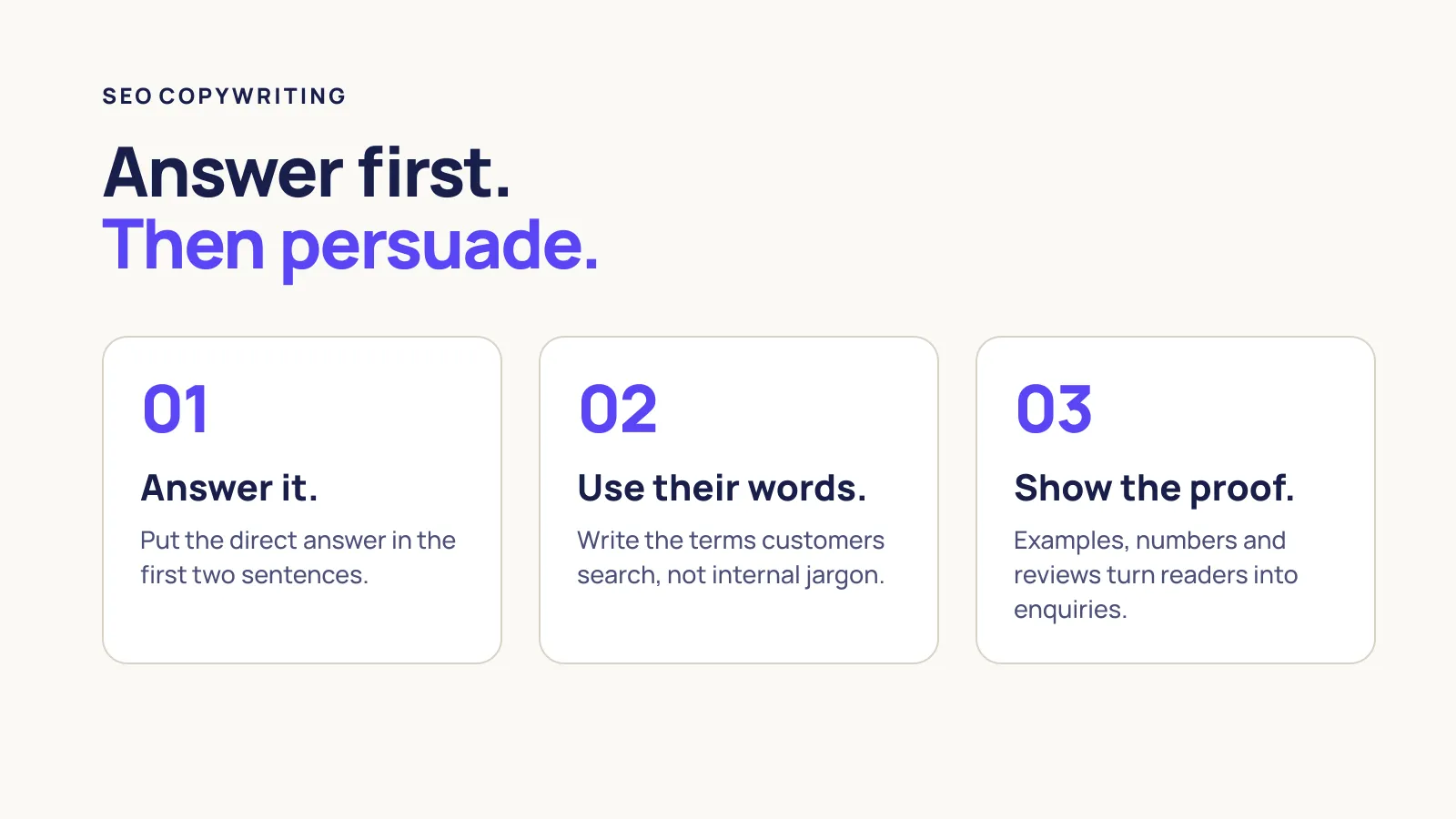
Good SEO copy answers the question in the first few sentences, uses the words your customers use (not your internal jargon), and covers what a reader needs to decide. It uses keywords naturally, with variations, instead of repeating one phrase until the page reads like spam. As a rough guide, we keep a page’s main keyword to around 0.5–1.5% of the words on it.
Google’s guidance on creating helpful, reliable, people-first content is the standard to write against. It asks whether a page shows first-hand experience, whether it adds something beyond what already ranks, and whether a reader would leave satisfied.
Our position on AI-written content
AI tools are useful for research and first drafts. Published as-is, they produce the same page as everyone else’s, because they’re trained on what already ranks. Google doesn’t ban AI content, but it rewards pages with experience, specifics and opinions, and AI can’t supply those. We’d rather publish one post a fortnight with real examples than four a week that could have been written about anyone.
SEO copywriting matters most on service pages, which are where enquiries come from. If those pages are thin, a blog won’t save them.
Content authority: owning a topic, not one keyword
Content authority is how search engines and AI tools decide that your website is a trustworthy source on a subject. It’s built across many pages over time, not on one.
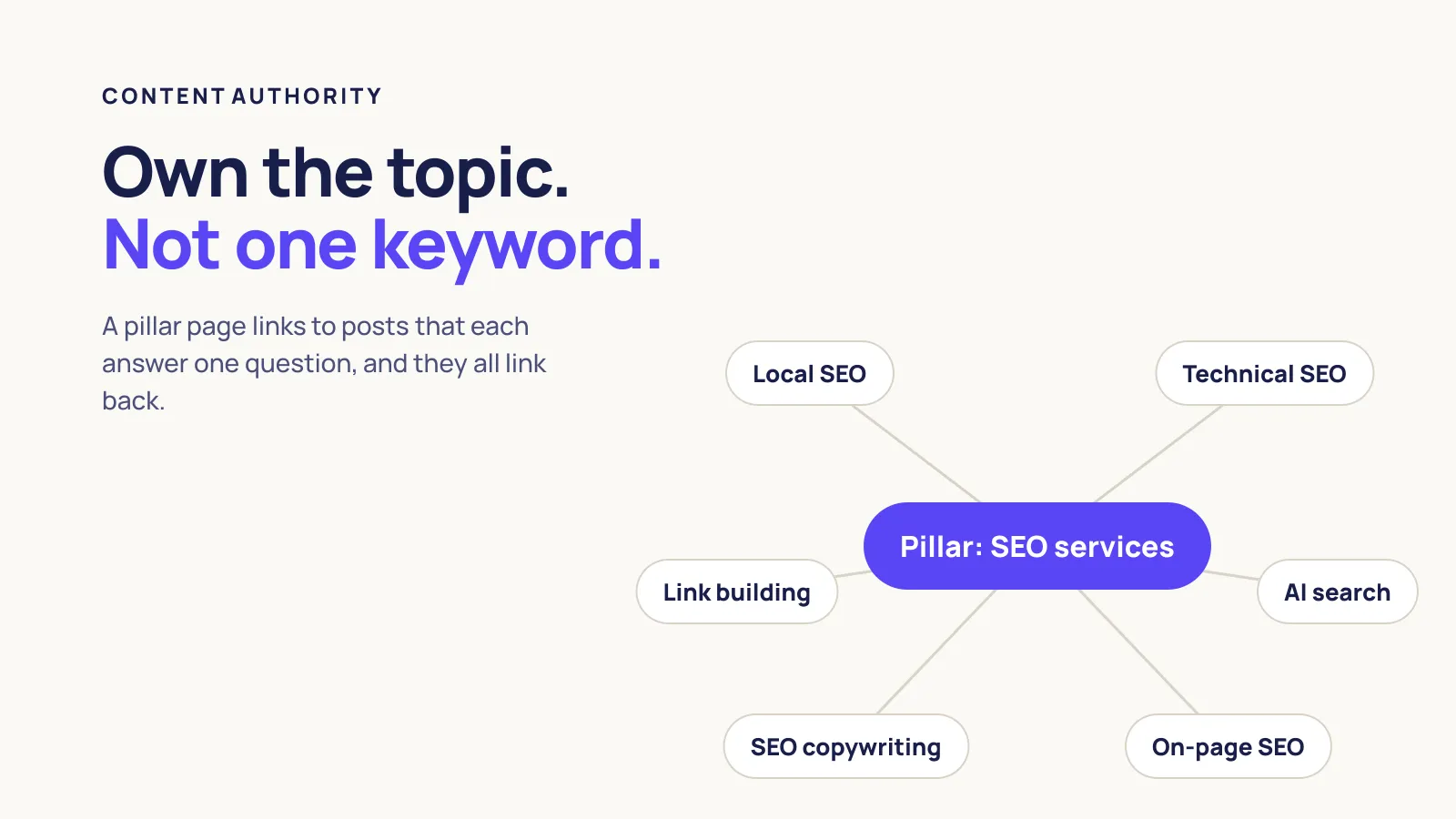
Topic clusters build authority faster than scattered posts
The usual structure is a pillar page, like this one, that covers a broad topic, linked to shorter posts that each answer one specific question. A pillar on SEO services might link out to posts on local SEO, technical audits or Google Business Profile, each linking back. That web of related pages tells Google you cover the topic in depth.
Scattered posts on unrelated topics do the opposite. Fifty blog posts across fifteen subjects build less authority than fifteen posts on one.
Experience and expertise have to be visible
Google’s guidelines refer to E-E-A-T: experience, expertise, authoritativeness and trust. In practice, that means named authors with real credentials, original examples and data, case studies, and an About page that explains who’s behind the business. These signals matter to AI tools too, which favour sources that look credible enough to cite.
Content authority is the slowest of the seven types to build, and the hardest for a competitor to copy once you have it.
Link building: earning trust from other websites
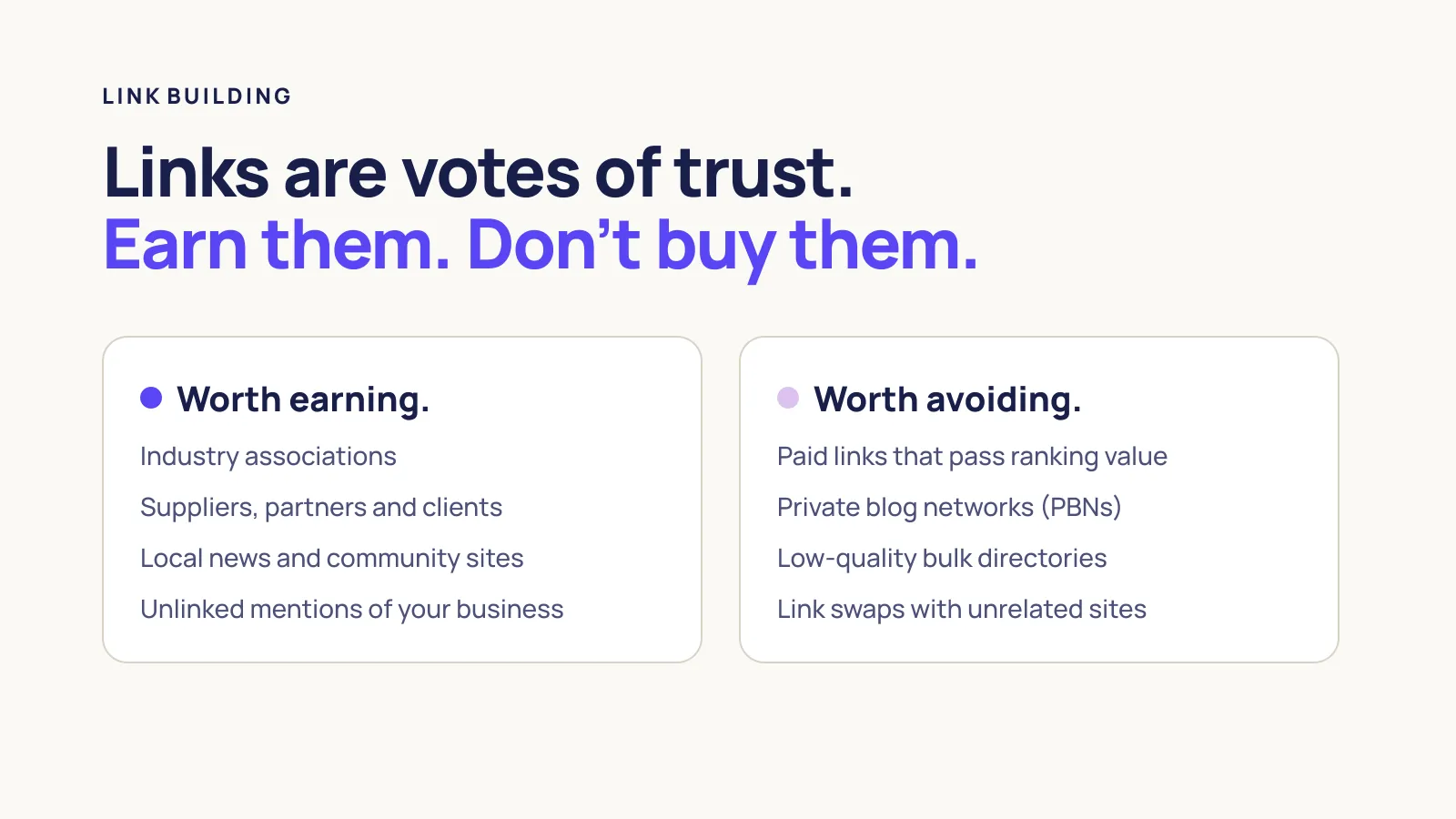
Link building is getting other websites to link to yours. Google treats a link from a relevant, trusted site as a vote of confidence, and links remain one of the strongest signals it uses.
What makes a good link
One link from an industry association, a local news site or a respected supplier is worth more than a hundred from low-quality directories. The best links come from websites your customers already trust, in your industry or your area, linking because your content is useful.
For Australian businesses, the most reliable sources are usually close to home:
- industry associations and member directories
- suppliers, partners and clients who list who they work with
- local business chambers, councils and community groups
- news coverage and expert commentary in Australian publications
- mentions of your business that don’t link yet, where a quick email can add the link
Buying links is against Google’s rules
Google’s spam policies are explicit: buying or selling links for ranking purposes counts as link spam, including paying for posts that contain links. Paid links are allowed only as advertising, marked with a nofollow or sponsored tag so they don’t pass ranking value.
Our position is simple. If an SEO provider promises a set number of links each month at a fixed price, ask exactly which websites they’ll come from. Private blog networks (PBNs) and paid guest posts can lift rankings briefly, then drop them when Google catches up.
Local SEO: showing up in Google Maps
Local SEO helps your business appear when people search for a service near them, such as “web developer Sutherland Shire” or “electrician near me”. It’s what puts a business in the map results at the top of Google.
How Google ranks local businesses
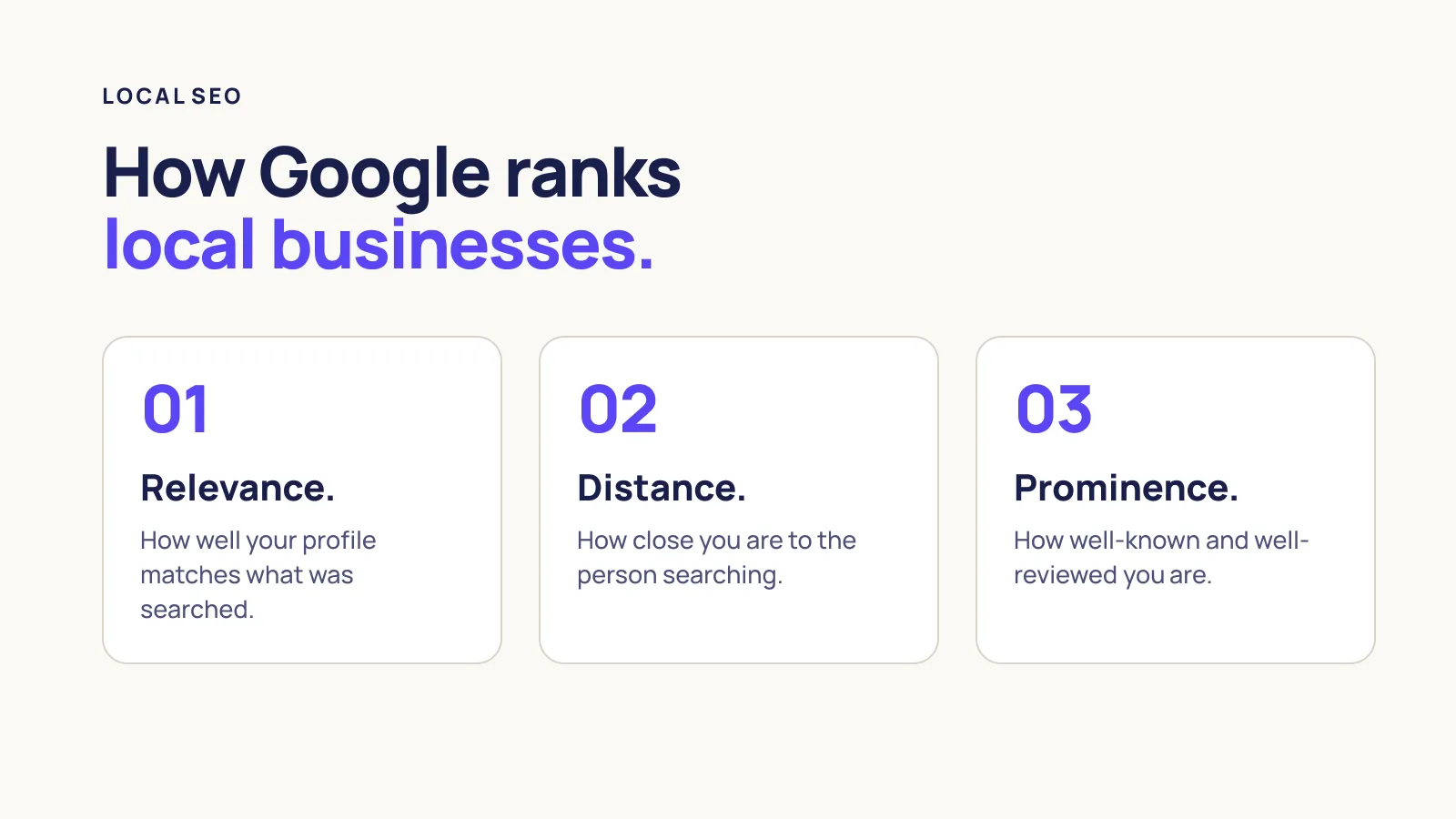
Google says local results are based mainly on relevance, distance and prominence: how well your profile matches the search, how close you are to the person searching, and how well-known your business is. You can’t change distance. You can improve the other two.
Local SEO services usually cover:
- setting up and completing your Google Business Profile, including categories, services, hours and photos
- getting more Google reviews, and replying to them
- keeping your business name, address and phone number identical everywhere online
- listings on Australian directories such as True Local, Yellow Pages and industry sites
- location pages on your website, where you genuinely serve that area
Small errors cost the most
When we audited our own setup in October 2026, we found that the Google Business Profile ID behind our website’s “5.0 rated on Google” badge and our schema pointed to a listing that didn’t exist. Every link to our reviews went nowhere. It took one line of code to fix, and nobody had noticed. Local SEO is full of small mismatches like this, and they’re why a profile can underperform while looking fine.
Reviews matter more than most businesses expect. Google’s own help page says more reviews and positive ratings can help local ranking. A steady flow of new reviews beats a burst of twenty in one week.
AI search: getting cited by ChatGPT and Google AI
AI search optimisation (also called AEO, answer engine optimisation, or GEO, generative engine optimisation) is making your business visible in answers from ChatGPT, Perplexity, Gemini and Google’s AI Overviews. More buyers now ask an AI tool for a recommendation before they search Google, so being named in those answers is becoming as important as ranking.
AI search builds on traditional SEO
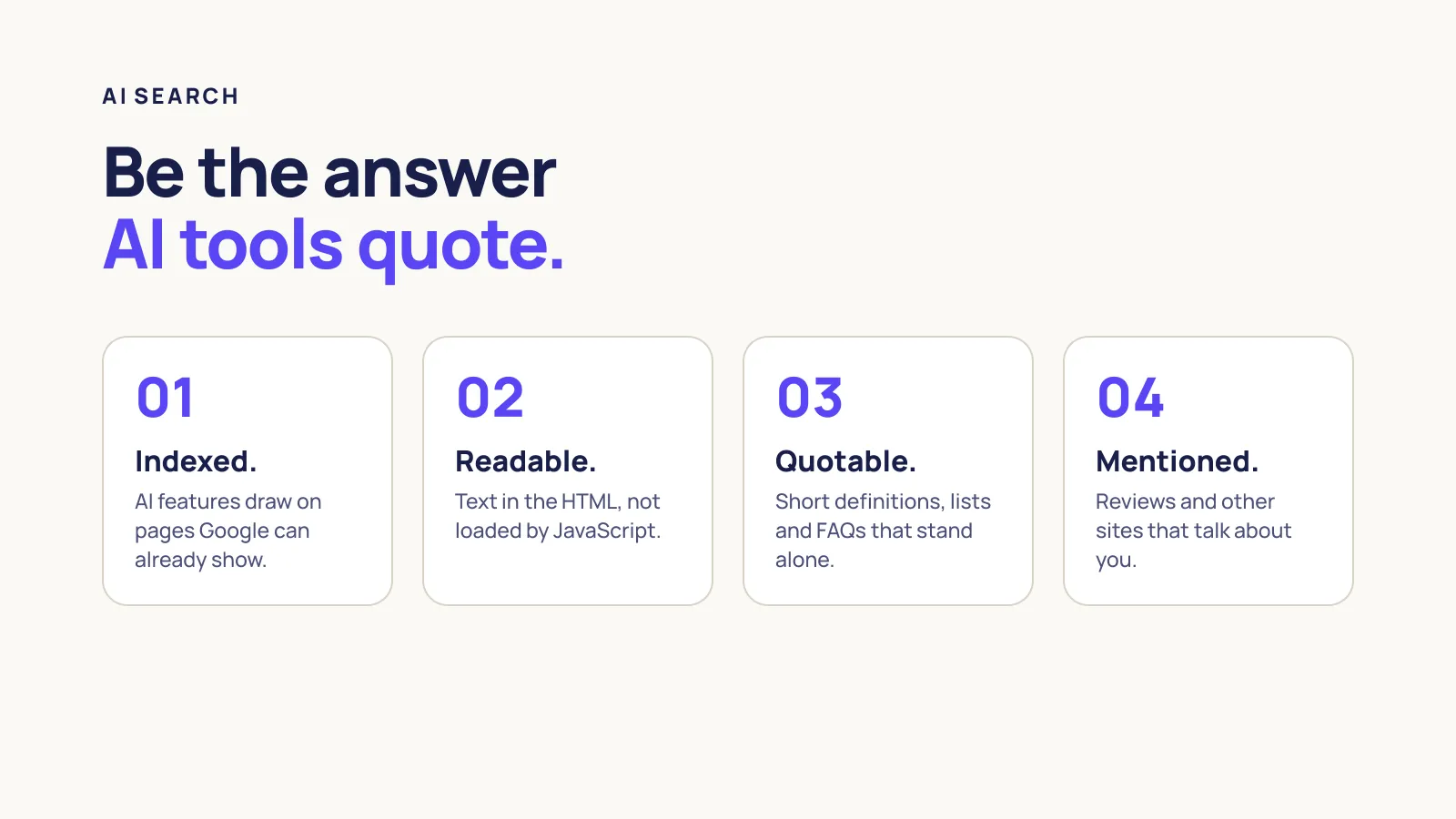
Google’s documentation for site owners is clear that there are no special requirements to appear in AI Overviews or AI Mode, and that standard SEO best practices still apply. A page has to be indexed and eligible for a normal search snippet first. That’s why we treat AI search as part of SEO, not a separate service to buy instead of it.
What makes AI tools cite a business
AI tools tend to quote content that answers a question directly and makes sense on its own: a clear definition, a short list, a comparison table. They also lean on what other websites say about you, such as reviews, directory listings, forum discussions and articles that mention your business.
The work usually includes:
- answer-first content, with definitions and FAQs written to be quoted
- structured data that labels your business, services and articles
- a site whose text is in the HTML, not loaded by JavaScript
- consistent, accurate business details across the web
- tracking a fixed set of prompts in ChatGPT, Perplexity and Google AI each month
Where we started
When we measured our own AI visibility in October 2026, Ahrefs found AI tools had cited our website zero times. An Australian competitor with a large blog had over 900 citations. ChatGPT named us in one of two runs for a Sutherland Shire prompt and in none of eight other prompts about our services. It also described an outdated version of our business. That baseline is why we’re publishing guides like this one, and why we now track 20 prompts each month to see what changes.
What SEO services cost and how long they take
SEO is usually sold in one of three ways:
- A one-off audit, which finds what’s holding the site back and gives a prioritised list of fixes.
- A one-off project, such as fixing technical issues, setting up local SEO or protecting rankings during a website rebuild.
- An ongoing monthly service, covering content, links, reporting and continued improvements.
What SEO services cost in Australia
There’s no fixed price for SEO, and anyone who quotes before looking at your website is guessing. Two websites in the same industry can need very different amounts of work.
As a guide, these are the price ranges you’ll typically see from Australian SEO agencies.
| SEO service | What’s usually included | Typical price (AUD) |
|---|---|---|
| SEO audit | A full technical and on-page audit with a prioritised fix list | $1,500–$5,000 |
| Content audit and plan | Reviewing existing content and planning what to update, merge or write | $2,000–$6,000 |
| Website migration or domain move | Redirect mapping, ranking protection and post-launch checks | $3,000–$10,000 |
| Entry-level monthly SEO | Keyword setup, light on-page fixes and one or two citations or links a month | $500–$1,000 a month |
| Growth monthly SEO | Keyword research, content, monthly link building, on-page work and conversion reporting | $1,500–$3,000 a month |
| Authority monthly SEO | Advanced technical SEO, large-scale content, link building and AI search | From $5,000 a month |
| SEO consulting | Hourly advice or training for in-house teams | $150–$300 an hour |
What affects SEO pricing in 2026
The price of an SEO service comes down to how much work your website needs, and how skilled that work has to be. Six things drive it:
- How competitive your market is. A bookkeeper targeting one regional city needs far fewer hours each month than a national online retailer competing across thousands of product searches.
- The size and condition of your website. An older site with years of outdated pages, broken links and duplicate content needs more technical cleanup before anything else can work.
- Where you want to be found. Ranking in one suburb or city costs less than ranking in several locations, or right across Australia.
- How much content it takes. AI search favours pages broken into clear sections, with sources and structured data, which takes more planning and writing than a standard blog post.
- How much trust your site needs to build. Earning links and mentions from other websites takes ongoing outreach, and it now matters for AI answers as well as Google rankings.
- Whether AI search is included. Tracking how your business appears in ChatGPT, Perplexity and Google AI Overviews adds reporting and optimisation work that wasn’t part of SEO a few years ago.
Which price range fits your business
Entry-level SEO suits a small business in a market with few competitors. Most small to medium businesses land in the growth range, because that’s the level where content and link building happen every month rather than occasionally. Authority SEO is for ecommerce stores and national brands competing for crowded searches.
Treat these as starting points rather than quotes, and ask for a proposal that explains what each month covers and why.
How long SEO takes to work
Timelines depend on the type of work. Technical fixes can show up as soon as Google recrawls the pages, which can be days for a small site. Content and links take months to build, because Google has to find, test and trust them. Be wary of anyone who promises page one by a date. Nobody controls Google’s rankings, and Google’s own advice on choosing an SEO says no one can guarantee a number one ranking.
Where SEO services go wrong
Most SEO disappointments come from a mismatch between what was sold and what the website needed. Some come from the client side too.
Mistakes on the agency side
Guaranteed rankings. No one can guarantee a position in Google. A promise like that usually means tactics that work briefly and then get penalised, or rankings for search terms nobody uses.
Reports full of vanity numbers. Impressions and ranking positions for obscure keywords look good in a monthly PDF. Ask for enquiries, calls and sales from organic search instead. If tracking can’t show those, fixing the tracking is the first job.
Content without strategy. Four blog posts a month on loosely related topics, written to hit a word count, rarely move anything. Fewer, better pieces aimed at the questions your buyers ask do far more.
Ignoring the website itself. Some SEO providers can’t touch the website, so they work around slow pages, broken templates and missing schema instead of fixing them. That’s like tuning a car with a flat tyre.
Mistakes on the client side
Redesigning without telling the SEO team. A new website that changes URLs without redirects can undo years of rankings within weeks. Bring your SEO provider in before the rebuild starts, not after launch.
Stopping after three months. Content and links take time to compound. Stopping just as they start working wastes most of the spend.
No one owns the Google Business Profile. Reviews go unanswered, hours go out of date and photos stay from 2019. Local SEO needs someone on your side checking in.
Our position
We’d rather a business spent its first months fixing the technical foundations and service pages than paying for content and links on a website that can’t convert the traffic. It’s less exciting to report on, and it’s almost always where the results come from.
Which SEO services does your business need?
Start with the problem, not the package. Use this as a guide:
- Pages aren’t showing up in Google at all, or rankings dropped suddenly. Start with a technical SEO audit.
- You rank, but for the wrong searches, or nobody clicks. On-page SEO and SEO copywriting on your main service pages.
- Most of your customers are local. Local SEO, starting with your Google Business Profile and reviews.
- Competitors outrank you with similar websites. Content authority and link building, usually both.
- Buyers say they found a competitor through ChatGPT. AI search visibility, built on the foundations above.
- You’re about to redesign or rebuild. SEO migration planning before the new site is built.
- You don’t know where you stand. An audit first. Paying for monthly SEO without one is guesswork.
Before you sign with any provider, ask what they’ll do in the first 90 days, how they’ll report on enquiries rather than rankings, and whether they can make changes to the website themselves.
SEO services vs Google Ads
They work differently and suit different goals. Google Ads buys visibility immediately and stops the day you stop paying. SEO takes months to build and keeps working without a cost per click. Most businesses do best with both: ads for leads now and for testing which keywords convert, SEO for the long-term cost of each enquiry. If budget only allows one, choose ads when you need enquiries this month, and SEO when you can wait for the payoff.
FAQs
What are the different kinds of SEO services?
There are seven main kinds: technical SEO, on-page SEO, SEO copywriting, content authority, link building, local SEO and AI search optimisation. Technical SEO makes sure Google can read your site, on-page SEO and copywriting match each page to a search, and content and links build trust. Local SEO gets you into Google Maps, and AI search gets you cited by tools like ChatGPT.
Is SEO worth it for a small business?
Usually, yes, if customers search for what you do. A small business with a clear service area and a strong Google Business Profile can compete with much larger companies in local results. The exception is a business whose customers don’t search online, such as one that runs entirely on referrals.
Can I do SEO myself?
Some of it. Setting up your Google Business Profile, asking for reviews and writing helpful content are all things a business owner can do well. Technical SEO, link building and AI search tracking take specialist tools and experience, and mistakes there can cost rankings.
Does SEO keep working after you stop paying for it?
The work you’ve done keeps working for a while, unlike ads. Rankings slip gradually as competitors keep improving and your content gets older. Most businesses move to a lighter ongoing plan once the foundations are in place, rather than stopping completely.
Do I need SEO if my website is new?
Yes, and a new website is the cheapest time to get it right. Structure, page titles, schema and speed cost little to build in from the start and more to fix afterwards.
Next steps
Webhaus is a Sydney web development agency for marketers, with SEO and AI search services built into how we build and look after websites.
- Ready to talk? Fill in our contact form and ask for a free Signals Scan of your website.
- Still learning? Read 10 Questions to Ask Website Design Services Before You Sign.
If you remember one thing about SEO services, make it this: fix what’s stopping Google from reading your website before you pay anyone to write or link to it.