The person who built your website left two years ago. Nobody is sure who holds the hosting login, the design file sits in a former staffer’s Figma account, and every small change goes to a developer you’ve never met. That’s usually when a business starts looking for a web design and development agency. This guide covers what one actually does, stage by stage, what it costs in Australia, what you should own at the end, and the mistakes we see on both sides of the table.
What is a web design and development agency? A web design and development agency is a business that plans, designs, builds and maintains websites for other organisations, with one team handling the whole job. That covers discovery, page structure, copywriting, visual design, the build on a platform such as Webflow, WordPress or Shopify, testing, launch and support afterwards. You deal with one contract and one point of contact instead of a separate designer and developer.
In this guide
- What a web design and development agency does, from first call to handover
- Source: 104% more enquiries after we rewrote the key pages
- Where web design and development projects go wrong
- How to tell if you need a web design and development agency
- Agency, or a designer and developer on staff?
What a web design and development agency does, from first call to handover
Our guide to what a web development company is sorts the five kinds of business that use the name. This section is about the work itself: who does what, what you have to supply, and what you should be holding when it’s finished.
One team runs every stage
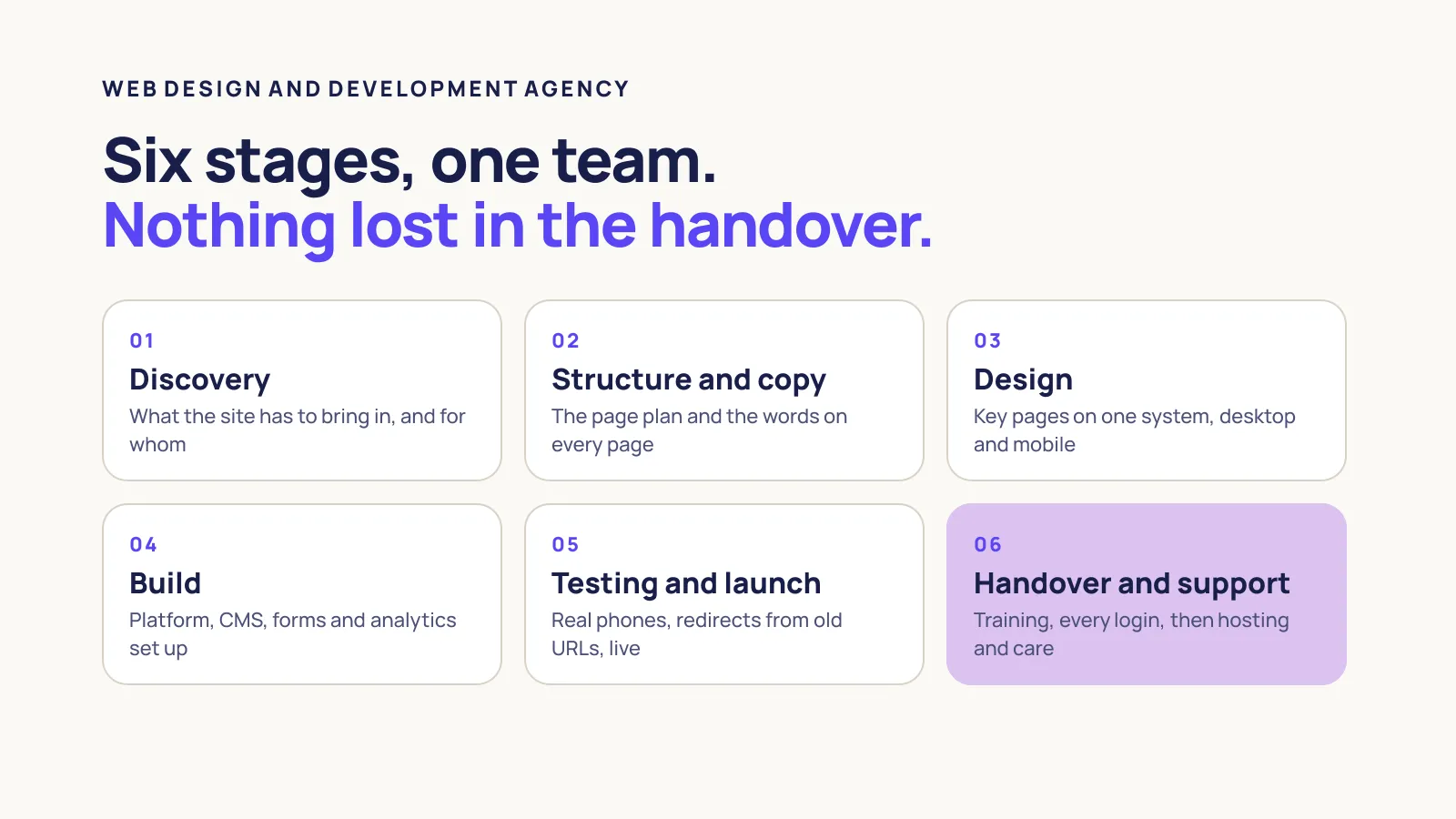
| Stage | What the agency does | What you supply or sign off |
|---|---|---|
| Discovery | Works out what the site has to bring in, who it’s for, and what’s broken now | Goals, numbers you have, logins to the current site |
| Structure and copy | Plans the pages and writes the words for each one | Facts, approvals on the copy |
| Design | Designs key pages on one consistent system, desktop and mobile | Brand files, feedback in agreed rounds |
| Build | Builds the site on the chosen platform, sets up the CMS, forms and analytics | Access to tools it connects to, such as your CRM |
| Testing and launch | Tests on real phones and browsers, sets up redirects from old URLs, goes live | Final approval |
| Handover and support | Trains your team, hands over every login, then hosts and maintains if you want | Who on your team will edit the site |
The value of one team is in the gaps between those rows. When the person writing the copy sits next to the person designing the page, a headline that runs to three lines on mobile gets fixed in the design file, not discovered after launch.
Design decides what people see and do
Figma, the design tool we and many agencies use, defines web design as “the craft of shaping the look and feel of a website or app”. In practice it’s also the order of the page: what a visitor reads first, what proves you can do the job, and where the enquiry button sits. A designer’s output is a file. Someone still has to build it.
Development decides whether it loads, ranks and gets read by AI
Development turns that file into a working site. Much of what Google measures, like speed and mobile layout, is set in the build. Google’s Core Web Vitals set a good score at the main content loading within 2.5 seconds, the page responding to a tap within 200 milliseconds and the layout shifting by 0.1 or less. Google also indexes and ranks the mobile version of your site, crawled as a smartphone.
AI search adds one more build decision. Vercel’s study of AI crawler traffic found that none of the major AI crawlers, including OpenAI’s GPTBot and Anthropic’s ClaudeBot, currently render JavaScript. If your page text only appears after scripts run, ChatGPT and Perplexity may not see it at all.
What it costs in Australia
These are our website design and development prices at Webhaus, fixed for a written scope:
| Project | What it usually includes | Webhaus price (ex GST) |
|---|---|---|
| Business website | 10 to 30 pages, copy, design, CMS, forms, analytics | $25,000 to $60,000 |
| Ecommerce store | Products, checkout, payments, stock and shipping | $30,000 to $75,000 |
| Landing page | One page for a campaign or ad group | $3,500 to $7,500 for the first page |
| Rebuild on a new platform | Everything above, plus keeping rankings and URLs | Build price plus $1,800 to $4,500 for SEO migration |
Hosting and maintenance sit on top, from $550 a month on our care plans. Our website projects take around 6 to 8 weeks. Late copy, photos and approvals stretch that more often than the build does.
What you should own when it’s handed over
IP Australia is blunt about the default: “IP created by a contractor is the property of the contractor unless otherwise stated in the contract.” That applies to the website and design files too. So before you sign, check the agreement puts these in your business’s name:
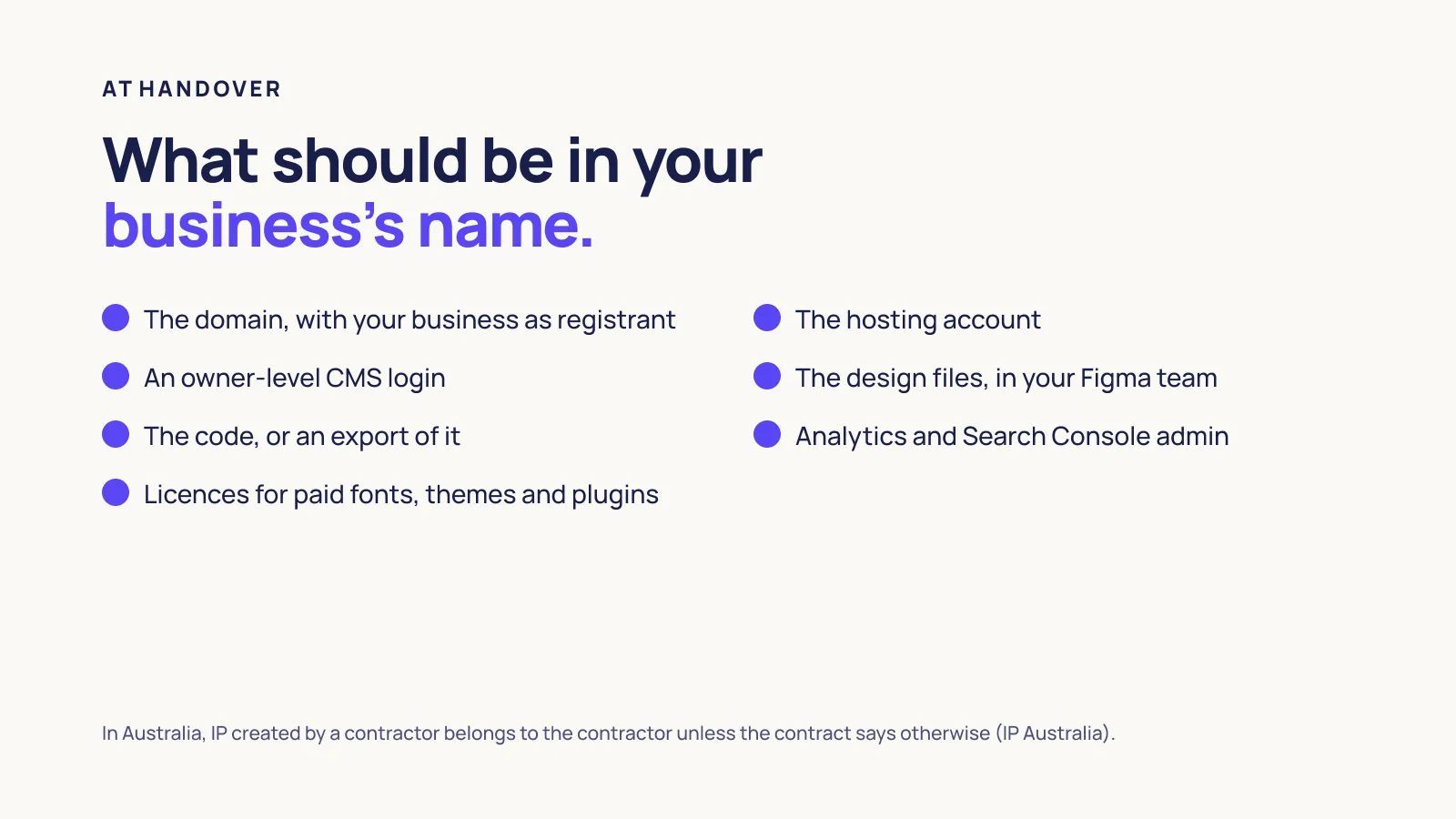
- the domain, with your business as the registrant
- the hosting account
- an owner-level login to the CMS
- the design files, in a Figma team you control
- the code, or an export of it
- Google Analytics and Search Console, with you as admin
- licences for paid fonts, themes and plugins
Source: 104% more enquiries after we rewrote the key pages
Source helps growing businesses manage legal, HR, safety, compliance, privacy and AI risk, from offices in Sydney, Melbourne, Brisbane and Perth. The services were strong. The website wasn’t saying so. Its copy could have belonged to any professional services firm, it didn’t name the clients Source wanted to win, and the key pages weren’t ready to take paid traffic. Source wanted to start advertising, and sending paid clicks to pages that listed practice areas and hoped people would work out which one applied to them would have wasted the spend.
What we changed
Our sister agency Vonnimedia had already done the positioning work, so we knew who Source was for and what it should say. We turned that into a messaging brief, rewrote the key pages around those clients, and redesigned them within the existing WordPress site. Copy and design were done together, page by page, by the same team. The new language names the clients Source serves and the problems it solves for them, so a visitor can tell within a few lines whether they’re in the right place. The layouts were built around that copy, with room for the proof points and a clear path to an enquiry on every key page.
We didn’t rebuild. The platform wasn’t what was holding Source back. The message was, so the budget went into the pages that carry it. The refreshed pages went live in the first week of August 2026.
The results
No paid advertising ran in either period, so these are organic results. Comparing the first three months after launch (August to October 2026) with the three months before (May to July), in Google Analytics:
- Form submissions rose from 22 to 45, up 104%.
- The conversion rate, form submissions divided by sessions, rose from 0.63% to 1.13%, up 79%.
- Sessions rose from 3,489 to 3,986, up 14%.
- Returning users rose from 534 to 619, up 15.9%.
In Google Search Console, impressions over the latest three months were about 185,000, against 148,000 in the three months before, up 25%. Clicks from Google held steady.
Three months is an early read, and we’ll update these numbers at the six-month mark. Organic traffic rose too, so not all of the extra enquiries came from the pages alone. The conversion rate is the cleaner measure, because it shows a bigger share of visitors getting in touch. The site didn’t get a new platform or a new look for its own sake. It got pages that say something specific, designed around what they say.
Where web design and development projects go wrong
Our position: hire one team for design and development unless you already have a finished design you’re happy with. Two suppliers means two contracts, and the problems we’re asked to fix often live in the gap between them. One team isn’t automatically better, though, and the mistakes below happen inside agencies too.
Mistakes we see from clients
Signing off a design filled with placeholder text is the most common. The page looks finished, then the real copy arrives twice as long and the layout breaks. Approve designs with real words in them.
The second is feedback by committee. Five people commenting on the same round, each with a different goal, turns two rounds into six. Pick one decision maker before the project starts.
The third is choosing the platform before deciding who will edit the site. A marketing team that publishes landing pages every week needs a different setup from a business that changes its site twice a year, and the answer should shape the platform choice, not follow it.
Mistakes we see from agencies
Accessibility gets left to the end. The Australian Human Rights Commission’s 2014 advisory notes on the Disability Discrimination Act state that “the provision of information and online services through the web is a service covered by the DDA”. The current standard is WCAG 2.2, published in October 2023. Colour contrast, headings and form labels are far cheaper to get right in design than to fix after launch.
Plugin pile-ups on WordPress are next. Patchstack’s 2026 report found 91% of new WordPress vulnerabilities in 2025 were in plugins, and 46% weren’t fixed by the time they were made public. Every plugin added to save build time becomes something else to keep patched.
Designs the CMS can’t repeat are a quieter problem. Every page is laid out by hand, so the site looks great at launch, but the next new page needs a developer because nothing was built as a reusable section. Ask to see how your team will add a page in the CMS before the design is signed off.
Then there’s the handover that’s just a password. If your team wasn’t trained on the CMS, every headline change still goes back to the agency, and you’re paying for a website you can’t run.
The trade-off with one team is concentration. If the agency is weak at design, everything it builds will look it. Ask to see two sites on the platform it’s recommending, and talk to the person who’ll design yours.
How to tell if you need a web design and development agency
You probably need one if:
- the site has to bring in enquiries or sales, and it isn’t
- you need copy written, not just pages built
- your team will edit the site weekly and needs a CMS set up for them
- you’re moving platforms and can’t afford to lose rankings
You probably don’t if:
- you already have a finished design and only need it built. That’s a developer’s job, and our guide to website development vs web design covers what they need from you
- the site is a simple placeholder for a new business, where a builder like Squarespace will do for now
- only a few campaign pages are underperforming, which a landing page can usually address in 1 to 2 weeks
When the quotes arrive, compare what’s excluded before you compare the totals. Copywriting, SEO migration, hosting, training and photography are the usual gaps, and in our experience a cheaper web design and development quote that leaves out two of them often ends up costing more by the time you’ve paid someone else to cover them.
If you do go ahead, ask each agency three things in the first meeting. Who will write, design and build my site, and are they on your team? What’s excluded from this quote? Whose name will the domain, hosting and code be in?
Agency, or a designer and developer on staff?
Indeed’s Australian data puts the average base salary for a web designer at $80,772 a year and a web developer at $88,333, so hiring both costs about $169,000 a year before superannuation and tools. That makes sense when your site changes daily and the work never stops. A freelance designer and a freelance developer sit in between, usually at a lower price than an agency, but you become the project manager who keeps the two of them talking. For most businesses, a fixed-price project and a monthly care plan cost less and cover copy, SEO and hosting that two hires might not.
FAQs
How involved do I need to be during the project?
Expect to give the agency a few hours at the start, then approvals at each stage: the page plan, the copy, the design and the final site. The projects that run late are the ones where approvals wait a week. Name one person who can sign off, and the timeline is far more likely to hold.
Can a new agency take over a website another agency built?
Yes, as long as you can give them access to the domain, hosting and CMS, and ideally the code. If any of those are in the old agency’s name, ask for them to be transferred before you start anything new. A good agency will check what you have access to before quoting.
Which platform is best for web design and development?
It depends on who will edit the site and what it has to do. In our experience, Shopify suits businesses selling products online, Webflow suits marketing teams who publish pages often without a developer, and WordPress suits sites that need a specific plugin, as long as someone keeps those plugins patched. Choose the platform after you’ve decided who runs the site, not before.
Is web design and development the same as SEO?
No, but they overlap. Design and development set the foundations Google reads: page speed, the mobile version, headings, page structure and whether the text is in the HTML. SEO builds on that over time, with keyword research, content and links from other sites, so a well-built site gives SEO a head start rather than replacing it.
What happens after the website launches?
Someone has to host it, update the platform and plugins, fix what breaks and check that forms still deliver. You can run that in-house or put it on a website maintenance plan. Either way, decide before launch rather than after the first problem.
Next steps
Ready to talk? Book a call and we’ll tell you what your site needs, and what it doesn’t, with a fixed price for the scope.
Comparing options? See how one team handled positioning, copy and design for Source, or what’s included in our website design and development projects.
Still learning? Start with what a web development company is and the five kinds you’ll come across in Australia.
Before you hire any web design and development agency, ask whose name the domain, hosting and code will be in, and get the answer in the contract.