Your phone rings from your Google listing. Most new work comes from word of mouth, and your Facebook page has a few hundred followers. So when someone says you need a website, it’s fair to ask what it would actually add.
Do I need a website for my business? For most Australian businesses the answer is still yes. Below is why a website is important, what it does that your other listings can’t, and when it’s fine to hold off.
Do I need a website for my business? Yes, if customers who don’t already know you have to find you, check you out or contact you. A Google Business Profile, social page or marketplace listing can bring enquiries, but the platform owns it and sets the rules. A website is the one place you control, and Google, AI tools and customers all use it to check you’re legitimate.
In this guide
- Why a website is important for a business
- What a website does that your other listings can’t
- Why it matters more now AI tools answer the questions
- Do tradies need a website?
- When you can hold off
- What a small business website needs
Why a website is important for a business
Customers check you out before they get in touch. BrightLocal’s 2026 consumer survey found that after reading positive reviews, 54% of consumers visit the business’s website, up from 32% in 2019. The survey is of US adults, and there’s no reason to think Australians behave very differently: the review gets you noticed, and the website helps decide whether they call.
A website also does a job your other listings can’t. Your Google profile shows your hours and reviews. Your website shows what you do, where you work, what it costs or how you price, and why someone should pick you over the three other businesses on the same map.
The third reason is ownership. Every other place your business appears belongs to someone else. Your website is the only one where you decide what it says, how it looks and where it’s hosted.
What a website does that your other listings can’t
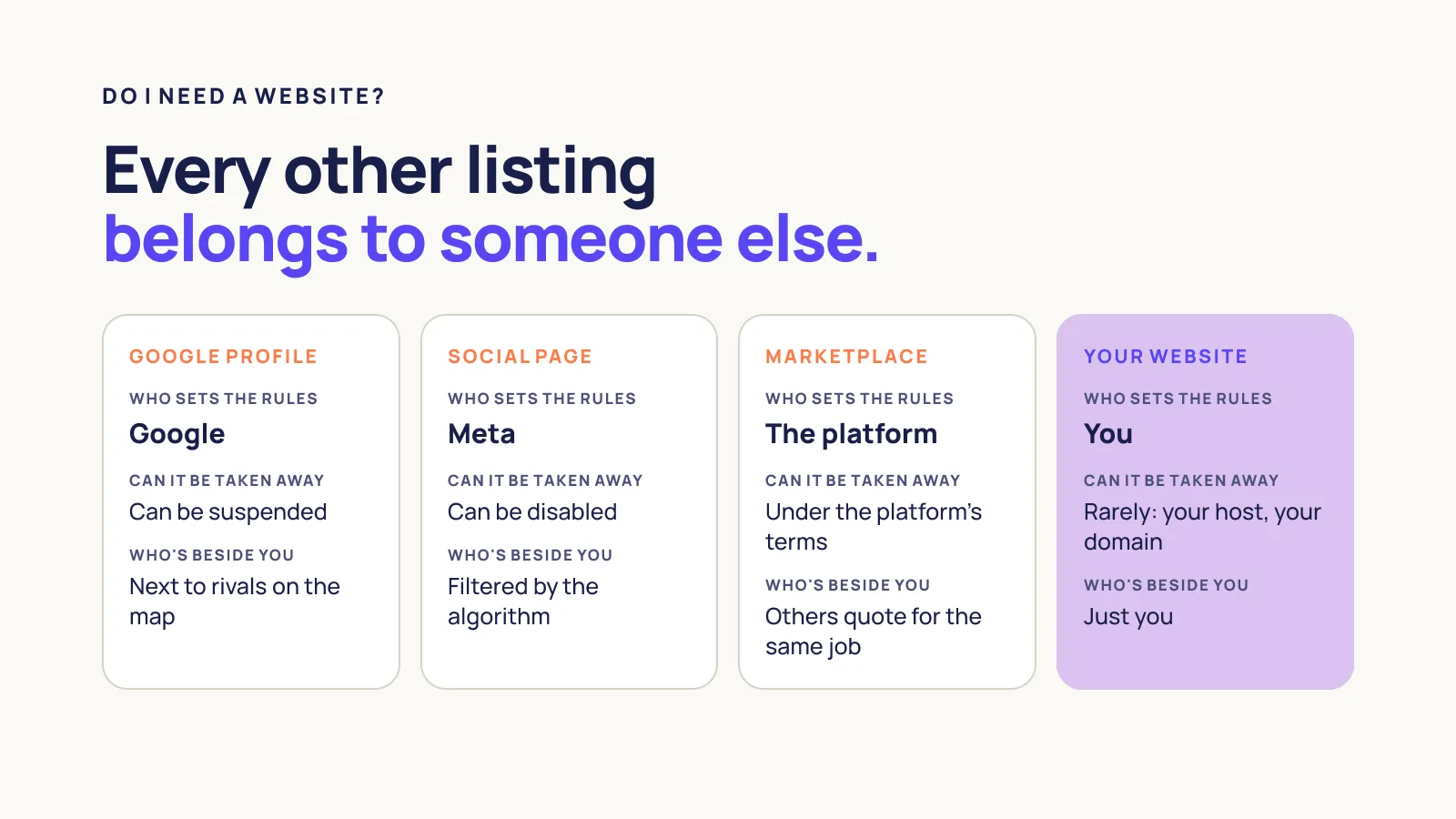
| Google Business Profile | Facebook or Instagram page | Marketplace (hipages, Airtasker) | Your website | |
|---|---|---|---|---|
| Who sets the rules | Meta | The marketplace | You | |
| Can it be taken away | Yes, it can be suspended | Yes, it can be disabled | Yes, under the platform’s terms | Rarely. You choose the host and own the domain |
| Who sees you | People searching Google and Maps | Your followers, filtered by the algorithm | People using that platform | Anyone who finds it through search, AI tools or a link |
| Competitors on the same page | Yes, on the map | Yes, in the feed | Yes, others quote for the same job | No |
None of this means you should drop the other listings. They bring work. The point is that each one can change overnight without asking you.
Google can suspend your profile. Google’s guidelines say it “reserves the right to suspend access to Business Profiles” that break its rules. If your profile is your only presence, a suspension means you’ve disappeared until it’s sorted.
Social reach depends on the algorithm. The Australian Government’s business.gov.au notes that how many people see your posts depends on “the platform’s algorithms”. Meta can also suspend accounts. Its help centre says you have 180 days to appeal, and if you don’t, or the appeal fails, the account is permanently disabled.
Your website helps the others work better. Google’s local ranking partly depends on prominence, which Google says is based on things like “how many websites link to your business” and your reviews. Your Business Profile also has a website field for a reason: it’s where people go next.
Why it matters more now AI tools answer the questions
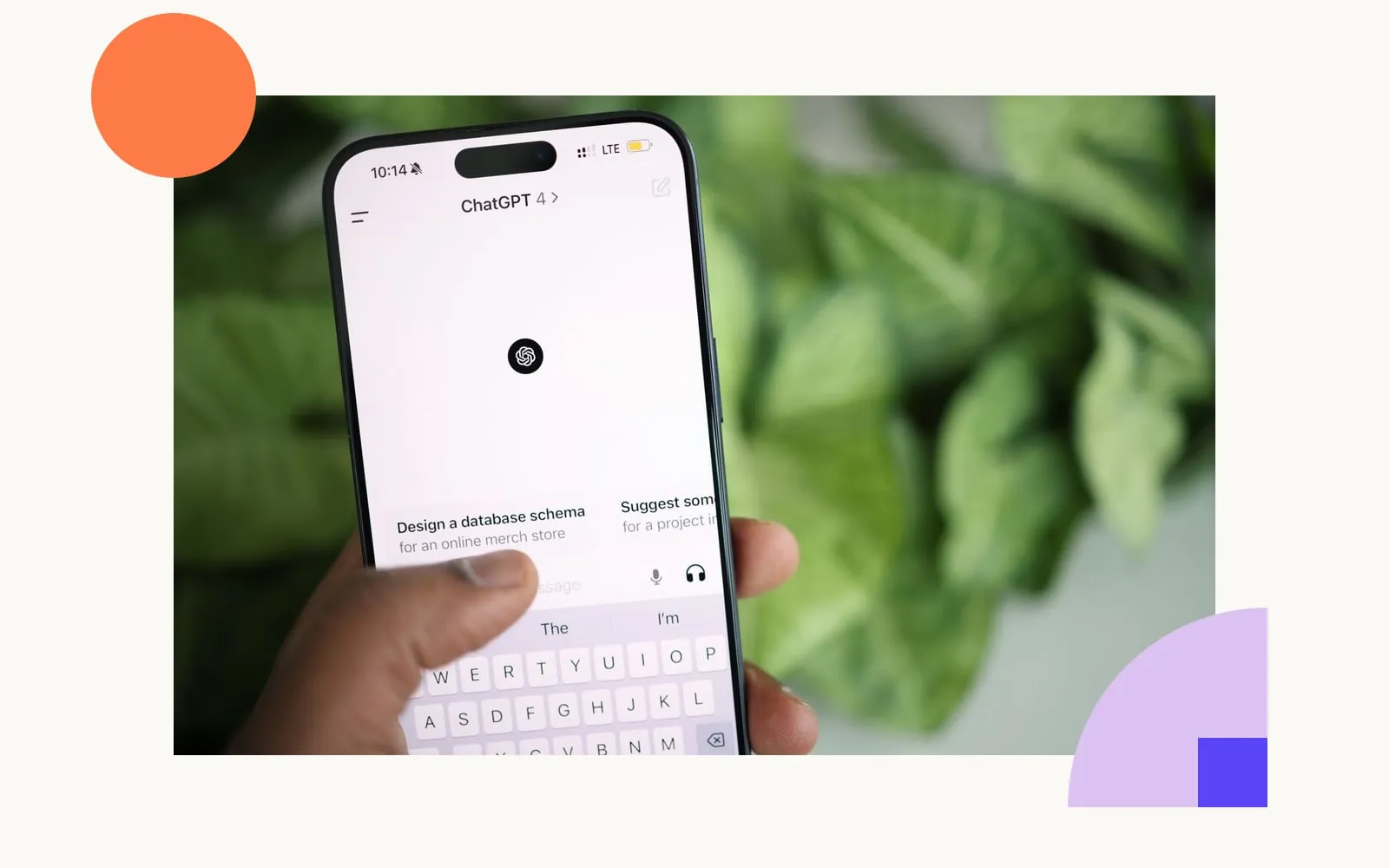
More people now ask ChatGPT or Google’s AI answers as well as searching. In BrightLocal’s 2026 survey, 45% of US consumers said they’d used AI tools like ChatGPT for local recommendations, up from 6% the year before. Those tools need pages to read.
ChatGPT’s search uses a crawler called OAI-SearchBot, which OpenAI says is used “to surface websites in search results”. Google says a page must be “indexed and eligible to be shown in Google Search with a snippet” to appear as a supporting link in AI Overviews or AI Mode. A business without a website has no page of its own for either tool to show or cite.
The newest example is ChatGPT’s business profiles. OpenAI launched them in beta on 10 November 2026, and claiming is “initially available to eligible businesses with a website”. We claimed the Webhaus profile this week by adding a record to our domain’s DNS settings. Local shops and restaurants in Australia can’t claim yet, as OpenAI only allows existing US local listings for now. Our guide on how to claim your business in ChatGPT walks through it.
Do tradies need a website?
Yes, though it doesn’t need to be big. A lot of tradie work comes from a Google listing or a marketplace, and that’s fine. In our experience, though, someone choosing between three plumbers taps through to see who’s real: photos of past jobs, the areas you cover, your licence number and a way to get a quote.
On a marketplace, other tradies quote for the same job. Your own site is a page where the customer sees only you. A clear one-page site with your services, service area, licence details and a quote form covers most of it.
When you can hold off
A website isn’t always the first thing to spend on. You can probably wait if:
- All your work comes through a few builders or contractors. If you’re a subcontractor and nobody new needs to find you, a website adds little for now.
- You’re still testing an idea. A free Google Business Profile, a business email and a registered domain name are enough while you find out if people will pay.
Register the domain name you want even if you’re not building yet. It costs little, stops someone else taking it, and lets you set up a professional email address now.
What a small business website needs
Most small business websites need less than you’d think, but each part has a job:
- What you do and where. A clear headline, your services and the suburbs, cities or regions you cover.
- Proof you’re real. Reviews, photos of real work, your ABN or licence number, and the names of the people behind the business.
- One clear next step. A phone number, quote form or booking link that’s easy to find on a phone.
- A page per main service. It helps Google match each search to the right page, and gives AI tools a clear answer to quote.
- Facts that match everywhere. The same business name, address, phone number and services on your site, Google profile and directories.
If you’d like help with the build, our website design service covers all five.
FAQs
Can I build my own website?
Yes. Wix, Squarespace and WordPress all let you build a simple site yourself, and that’s a reasonable start for a sole trader. It’s worth getting help when you need the site to rank on Google, connect to your booking or CRM tools, or bring in more enquiries than it does now.
Is a one-page website enough?
For a sole trader with one or two services, often yes. As you add services or locations, separate pages work better, because each page can answer one search clearly. One page can only be the best answer to a few questions.
Will a website get me on Google straight away?
Not straight away. Google has to find and index your pages first, and Google says crawling can take “anywhere from a few days to a few weeks”. Add your site to Google Search Console and submit your sitemap to help Google find it sooner, and link to it from your Business Profile.
Next steps
Ready to talk? If you’re weighing up a new website, get in touch and we’ll tell you honestly whether you need one yet and what it should include.
Comparing options? See what’s included in our website design service.
Still learning? Read about the difference between website development and web design.
So, do I need a website for my business? If new customers need to find and trust you, yes, and it’s the one listing nobody can take away.