Search for the best Webflow agency and you’ll find three or four ranked lists. Each puts a different agency at number one, and in most cases it’s the agency that wrote the list. The directories aren’t neutral either. Clutch and DesignRush both sell sponsored placements, and DesignRush says its sponsored listings appear above the organic ones.
A more useful question is which Webflow agency suits your site. You can answer that with a handful of checks before you sign, and they’re all below, along with what a Webflow site really costs in Australia and a client example with the numbers.
Who’s talking. Almas Tariq is an SEO Specialist and Copywriter at Webhaus with six years in search engine optimisation. She leads SEO for Australian brands, covering technical, on-page, local and content SEO, blog authority and AI search visibility.
What is a Webflow agency? A Webflow agency is a design and development team that builds and maintains websites on Webflow, a visual website platform with its own hosting and content management system (CMS). It usually handles design, the build, CMS setup, SEO settings and training, and charges for the build separately from the Webflow plan that hosts the site.
In this guide
- How to judge a Webflow agency on what you can check
- Platinum DJ Services: what a Webflow rebuild changed
- Where Webflow projects go wrong
- How to choose a Webflow agency: seven questions
- Is Webflow or WordPress the better call?
How to judge a Webflow agency on what you can check
Portfolio and reviews tell you whether an agency can make a site look good. They don’t tell you who’ll own it, what it costs to run, or whether anyone will find it. Those are the things that separate the best Webflow agency for your business from one that simply has a nice showreel.
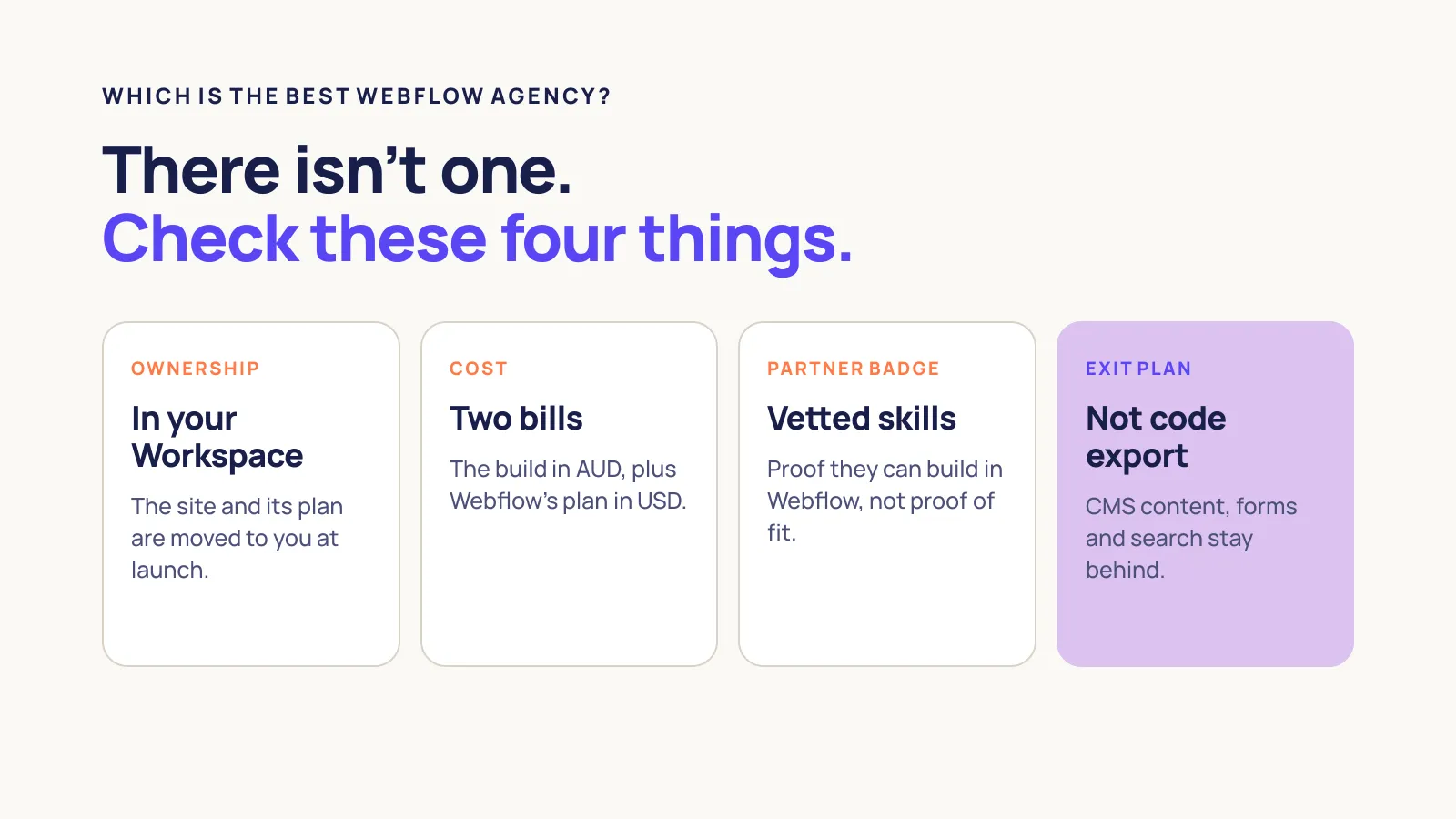
We’d check four things, in this order: what kind of team you’re hiring, what the partner badge actually proves, the full cost in Australian terms, and who holds the keys after launch. Each one takes a single question to answer, and an agency that’s evasive on any of them has told you something.
A Webflow agency, a freelancer or a general web agency
| Webflow freelancer | Webflow agency | General web agency | |
|---|---|---|---|
| Who does the work | One person, design and build | A team: design, build, SEO, account management | A team across several platforms |
| Suits | A small site with a clear design | A marketing site your team edits often | Businesses not set on a platform yet |
| What we’d check | Who covers when they’re sick or busy | Who actually builds your site | How many Webflow sites they built this year |
We’d pick a freelancer for a five-page site with the design already done. Once the site has several page types, a CMS your marketing team uses weekly, and SEO that matters, a team earns its fee because someone owns each part.
A general web agency isn’t a worse choice by default. The question is whether the people building your site use Webflow every week. Ask to see their last three Webflow builds, not their best three.
The Certified Partner badge tells you less than it looks
Webflow says all its Certified Partners “have been thoroughly vetted and qualified by the Webflow team”, and its expert directory lists over 1,200 of them. To apply, an agency needs a paid Freelancer or Agency Workspace plan, has to pass a pre-qualification assessment, and submits three client sites built from scratch in Webflow.
That’s a real bar, and Webhaus is a Certified Partner. But it proves competence on the platform, not fit for your project. The Partner Program has three tiers: Foundations (entry level), Certified and Premium. “Enterprise” is a separate badge for partners who sell Webflow Enterprise. Webflow also pays partners 10–20% commission on the Site plans and add-ons they sell, for the first 12 months, so ask any agency how it recommends a plan.
What a Webflow site really costs in Australia
You pay two bills. The agency charges for the build, usually in Australian dollars. Webflow charges for the Site plan that hosts the site, in US dollars, with tax added at checkout.
| Webflow plan (billed yearly) | Price |
|---|---|
| Basic Site plan (no CMS) | US$15 a month per site |
| Premium Site plan | US$25 a month per site |
| Team Platform plan | US$2,500 a month, annual contract |
Source: Webflow pricing, November 2026. Basic is for sites that don’t need a CMS, so a site with a blog or case studies needs Premium at least.
Build costs depend almost entirely on scope. One published Australian guide, What’s The Damage, puts a marketing or brand site at $8,000 to $30,000 and a landing page at $2,000 to $6,000. Treat those as a rough range. The number of page templates, CMS collections and integrations, and whether copywriting is included, move the price more than the platform does.
Because Webflow bills in US dollars, the running cost in Australian dollars moves with the exchange rate. Ask the agency to put the plan, its yearly cost and whose card it’s billed to in the proposal, next to the build price.
Who owns the site when the agency is done
This is the check most people skip. An agency can build in its own Workspace and then transfer the site to yours, with the plan and custom domain moving across. You can then add the agency back as a guest. Ask for that in writing before you sign.
Don’t rely on code export as your exit plan. Webflow’s help centre says CMS content, ecommerce data and localised pages aren’t included in exported code, and forms and site search stop working. CMS items can be exported as CSV, but the site itself has to be rebuilt elsewhere, so ownership of the Workspace matters more than a ZIP file.
Platinum DJ Services: what a Webflow rebuild changed
Platinum DJ Services had fifteen years of reputation in Sydney’s wedding and events market and a website that didn’t show it. The site was a DIY build. It already had decent organic traffic, but that traffic wasn’t turning into enquiries, and the business was talking to couples, corporate clients and private-party hosts in one voice.
The brief was simple to say and hard to do: move beyond word of mouth and win more of the premium wedding, corporate and event work the team was already qualified for. A premium service was being undersold by an amateur-looking site.
The problem was the message, not the platform
A better-looking site with the same vague lines wouldn’t have moved anything. So the first work was mapping the three audiences and writing a separate case for each: couples planning a wedding, companies booking a corporate function, and people throwing a private celebration. Each got the reasons that matter to them before they book.
What we changed
A new logo and colour palette gave the business a look that matched the standard of its work. We designed the homepage and key pages on one consistent system, with room for the photography and social proof that do the convincing. Then we built it in Webflow with a CMS the team runs themselves, and handed it over with training so new work goes live without a developer.
The result
After the rebuild, organic traffic rose 74% and session duration rose 51%.
In our view, the platform made the CMS easy to hand over, but the gains came from the messaging and structure. A longer session usually means people are reading the page that speaks to them instead of bouncing off a generic one.
That’s the lesson for anyone shortlisting Webflow agencies. Ask each one what they’d change about your message, and how they’d split your audiences, before you look at a single mockup. The best Webflow agency for a business like Platinum DJ is the one that asks those questions first.
Where Webflow projects go wrong
“Best” lists are marketing
Clutch says “We may earn a fee for some placements”, and DesignRush says sponsored listings “pay for a placement that appears above organic positions”. The agency-written lists we read, from Flow Ninja, Raw.Studio and Web Tonic, each ranked the author first. (Web Tonic’s Sydney list includes Webhaus further down.) Use them to build a shortlist, never to decide.
Renting your own website
When the site and its plan sit in the agency’s Workspace, you can edit the content but you don’t control the account. If the relationship ends badly, getting the site back is a negotiation, and the agency holds the stronger hand.
We’d make the Workspace transfer a contract term on every project, with the plan billed to the client’s card from launch day.
Leaving SEO until after launch
Webflow can generate an XML sitemap and publish 301 redirects without a developer. The tools aren’t the problem. The problem is nobody mapping every old URL to its new one before the switch, which is how a redesign loses rankings it took years to earn.
Using Webflow for the wrong job
Webflow suits content-led marketing sites: service businesses, agencies, SaaS marketing sites, anything where the team publishes pages and posts often. We’d point most online stores to Shopify and anything with logins, accounts or complex logic to custom code. In our experience, agencies that only build on Webflow rarely say that out loud. Platforms also change underneath you. Webflow shut down its Logic automation tool on 27 June 2025, and sites that relied on it had to rebuild those flows in tools like Zapier or Make.
Content arriving last
On the client side, the most common delay we see is copy and images arriving after the design is signed off. The build stalls, the launch date moves, and the site goes live with placeholder text on pages nobody had time to finish.
The fix is boring and it works: agree who writes what, and by when, before design starts. If the agency offers copywriting, decide at the proposal stage whether you’re buying it.
How to choose a Webflow agency: seven questions
Ask every agency on your shortlist the same questions, in writing:
- Will the site and its Site plan sit in our Workspace, or will you transfer it to us at launch?
- Which Site plan do you recommend, and why that one?
- What does the quote include: copy, page templates, CMS collections, integrations, training?
- Who maps the old URLs and sets the 301 redirects before launch?
- Who on your team will actually build our site, and who do we talk to each week?
- Can we see three live Webflow sites you built, and talk to one of those clients?
- When would you tell us Webflow is the wrong platform for us?
Compare the answers side by side. Vague answers to the first two questions are the biggest red flag, because they decide whether you own the site and what it costs to run for years.
The last question is the most useful. An agency that only builds on Webflow has every reason to say yes to your project. One that also builds on other platforms can give you a straight answer, which is why we ask it of ourselves on every first call.
Is Webflow or WordPress the better call?
WordPress runs 57.5% of websites with a known CMS, against 1.2% for Webflow. In our view, that gap reflects WordPress’s age and plugin ecosystem more than quality. We’d choose Webflow when a marketing team needs to publish and edit pages without a developer, wants hosting and security handled by the platform, and the site doesn’t depend on plugins. WordPress makes sense when you’re already on it, your team knows the editor, or a plugin does a job Webflow can’t. For everything else, start with what the site has to do, then pick the platform.
FAQs
Is Webflow good for SEO?
Yes, if it’s set up properly. Webflow generates an XML sitemap, supports 301 redirects and canonical tags, and lets you upload an llms.txt file on a custom domain, although its own help centre says the effect of llms.txt on AI search is unclear. Rankings still come from the content and the links, not the platform.
Can I build a Webflow site myself?
You can. Webflow has a free Starter plan for building and learning, and a simple site is a reasonable DIY project. Most businesses bring in an agency when the site needs a CMS structure the team can’t break, migration from an old site, or SEO that has to be right on day one.
How long does a Webflow build take?
It depends on the number of page templates and how quickly content arrives. Ask any agency what the timeline assumes about your content and approvals.
Next steps
Ready to talk? Book a call with a senior strategist and we’ll tell you whether Webflow suits your site, and what the build and plan would cost.
Comparing options? See how we build on Webflow on our webflow agency page, or read the Platinum DJ Services case study.
Still learning? Read about the difference between website development and web design.
The best Webflow agency for you is the one that puts the site in your name and quotes both bills up front. Ask those two things first.