
You ask two agencies to quote SEO for the same website. One comes back at $900 a month, the other at $3,500. Both send a list of deliverables that looks almost identical, and both promise more traffic.
Both quotes are “normal” for Australia, because SEO is priced in four different ways and each tier includes very different work. Below are the four pricing models, the price ranges for each, what a typical monthly tier includes, and how to tell which quote is worth paying.
What is SEO pricing? SEO pricing is what an agency, freelancer or consultant charges to improve how your website ranks in Google and appears in AI search. In Australia it’s sold four ways: a monthly retainer, an hourly rate, a fixed-price project such as an audit or migration, or a performance-based deal. The price pays for the people, their time and their tools.
In this guide
- Monthly SEO pricing tiers in Australia
- Hourly, project and performance-based SEO pricing
- What in-house SEO costs compared with an agency or freelancer
- Where SEO budgets get wasted
- How to set your SEO budget
- How AI search changes what you pay for
Monthly SEO pricing tiers in Australia
Most agencies sell ongoing SEO as a monthly retainer, because rankings move over months rather than weeks. Google’s own SEO Starter Guide says some changes “could take several months” to show up. The ranges below come from our review of eight Australian agencies’ published pricing in October 2026. Treat them as a guide, since the real SEO cost depends on your site and your market.
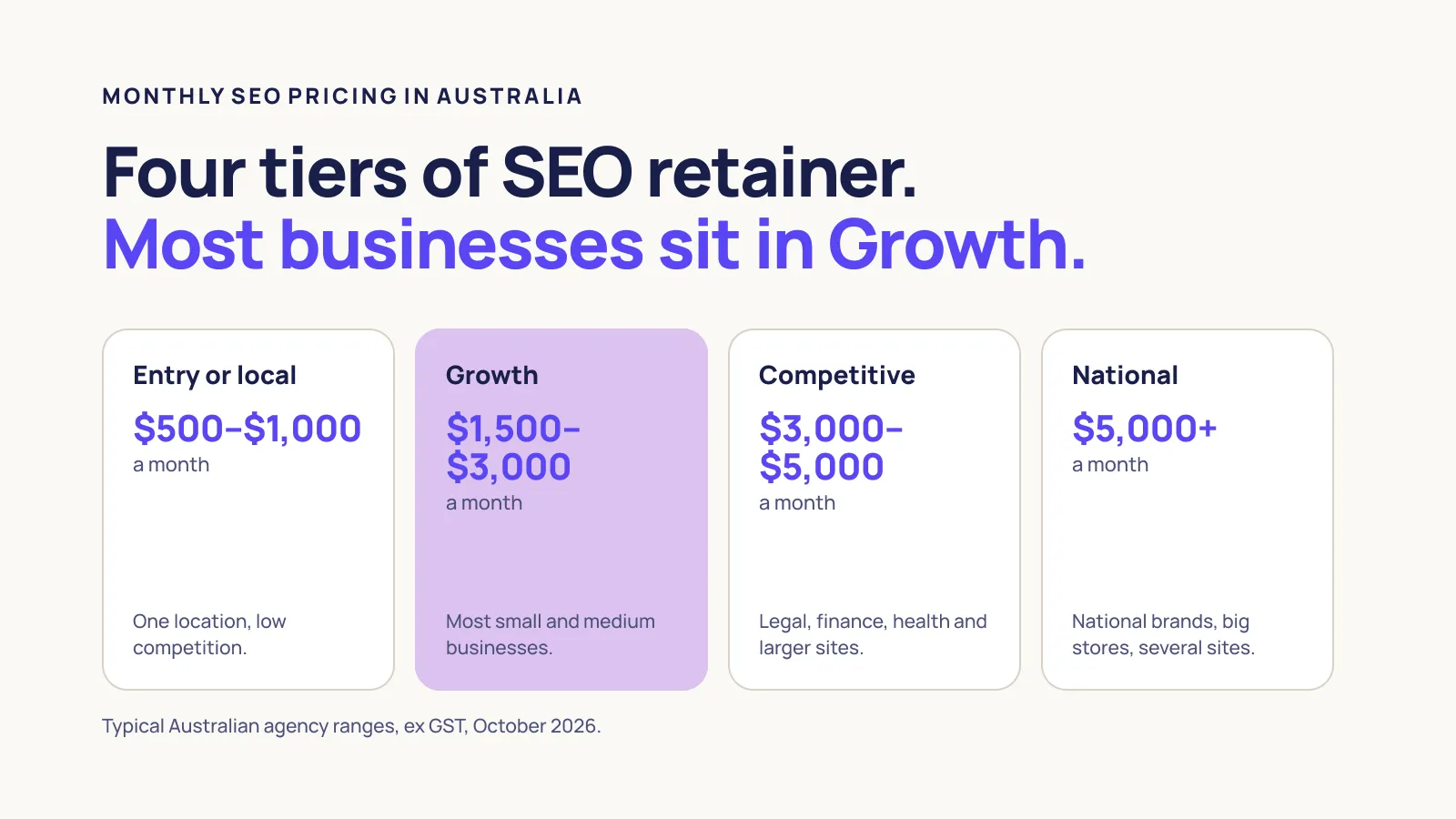
| Tier | Typical monthly SEO cost (ex GST) | Usually suits |
|---|---|---|
| Entry or local | $500 to $1,000 | A single-location business in one suburb or town, low competition |
| Growth | $1,500 to $3,000 | Most small and medium businesses targeting a city or region |
| Competitive | $3,000 to $5,000 | Busy markets such as legal, finance or health, or larger sites |
| National or enterprise | $5,000 and up | National brands, big ecommerce catalogues, several locations |
Entry or local SEO: $500 to $1,000 a month
This is where many local businesses start, and where most local SEO pricing sits. It usually covers:
- Google Business Profile updates and review management
- Basic on-page fixes to your main service pages
- Listings on a handful of local directories
- Rank tracking for a short list of local searches and a monthly report
Expect to hold or slowly lift your position in one area. It’s the right budget for a tradie who already ranks in one suburb. It won’t move a business into a new city or service line.
Growth SEO: $1,500 to $3,000 a month
This is the realistic band for most small and medium businesses, and where an agency can fix, improve and add in the same month. It usually adds:
- Keyword research tied to the services that bring in work
- Ongoing technical SEO, from crawl errors to page speed
- New content, such as a service page or article each month
- Outreach-based link building
- Reporting on enquiries, calls and form submissions, as well as rankings
Competitive SEO: $3,000 to $5,000 a month
Legal, finance, health and other crowded markets need more of everything: more content, more links and deeper technical work. This tier also suits larger service sites and businesses targeting several cities.
National or enterprise SEO: $5,000 a month and up
National brands, ecommerce stores with thousands of products and businesses running several sites sit here. Expect a dedicated strategist, content at scale, technical work across large sites and AI search visibility built into the plan.
What moves you up a tier
- Competition. Ranking for “plumber Wollongong” takes far less work than “home loans” across Australia.
- Site size and health. A 2,000-product store with broken redirects needs more technical work than a 15-page service site.
- Content. Writing new pages is often the biggest single cost in a growth retainer.
- Who implements the fixes. If your agency can’t change the website and has to hand a list to your developer, add the developer’s time to the real cost.
Hourly, project and performance-based SEO pricing
Not everyone needs a retainer. These three models suit specific jobs, or businesses with someone in-house to do the work.
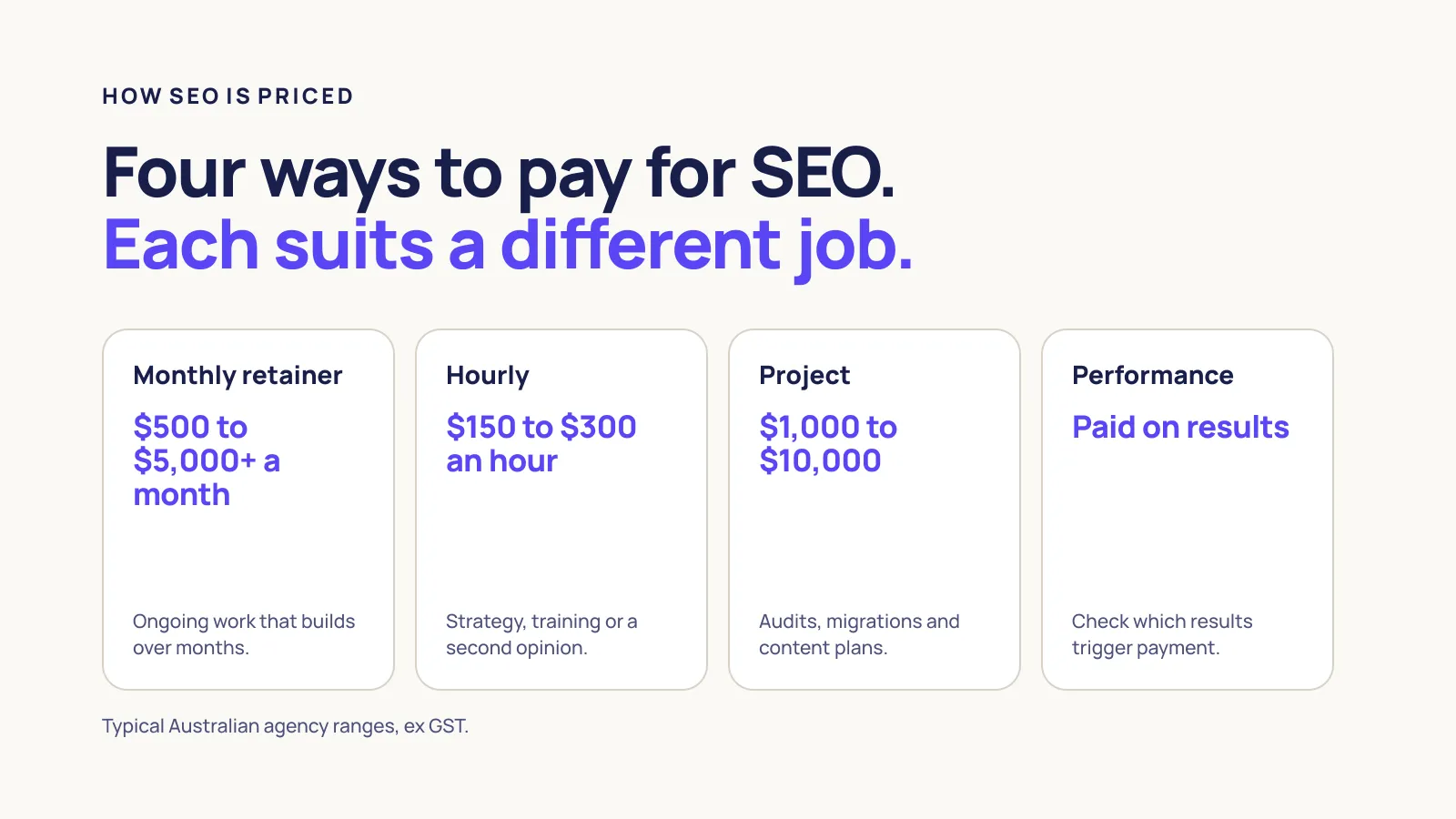
Hourly SEO pricing: $150 to $300 an hour
Agencies and senior consultants in Australia usually charge $150 to $300 an hour, and freelancers often less. Hourly works well for strategy sessions, training an in-house marketer or a second opinion on a quote. It’s harder to budget for ongoing work, because the bill depends on how long each task takes.
Project-based SEO pricing
A site that dropped after a redesign, or one that was never set up properly, often needs a fixed piece of work before anything else.
| Project | Typical price (ex GST) |
|---|---|
| SEO audit with a prioritised fix list | $1,000 to $5,000 |
| Website migration or domain move | $3,000 to $10,000 |
| Content audit and plan | $1,500 to $5,000 |
Projects suit one-off problems with a clear end. The audit tells you what’s wrong, but someone still has to fix it, so check whether the fixes are included or quoted separately. If you’re rebuilding, our guide to website redesign costs covers what the SEO migration should include.
Performance-based SEO pricing
Some providers offer to charge only when you rank. The catch is who picks the keywords. Ranking for obscure phrases nobody searches is easy, so the deal pays out without bringing you enquiries. If you’re offered one, ask to tie payment to organic enquiries rather than positions, and see how the offer changes.
What in-house SEO costs compared with an agency or freelancer
Agency retainers look expensive until you price the alternative. Hiring someone to do SEO full time costs more than most businesses expect.
A full-time SEO specialist costs more than most retainers
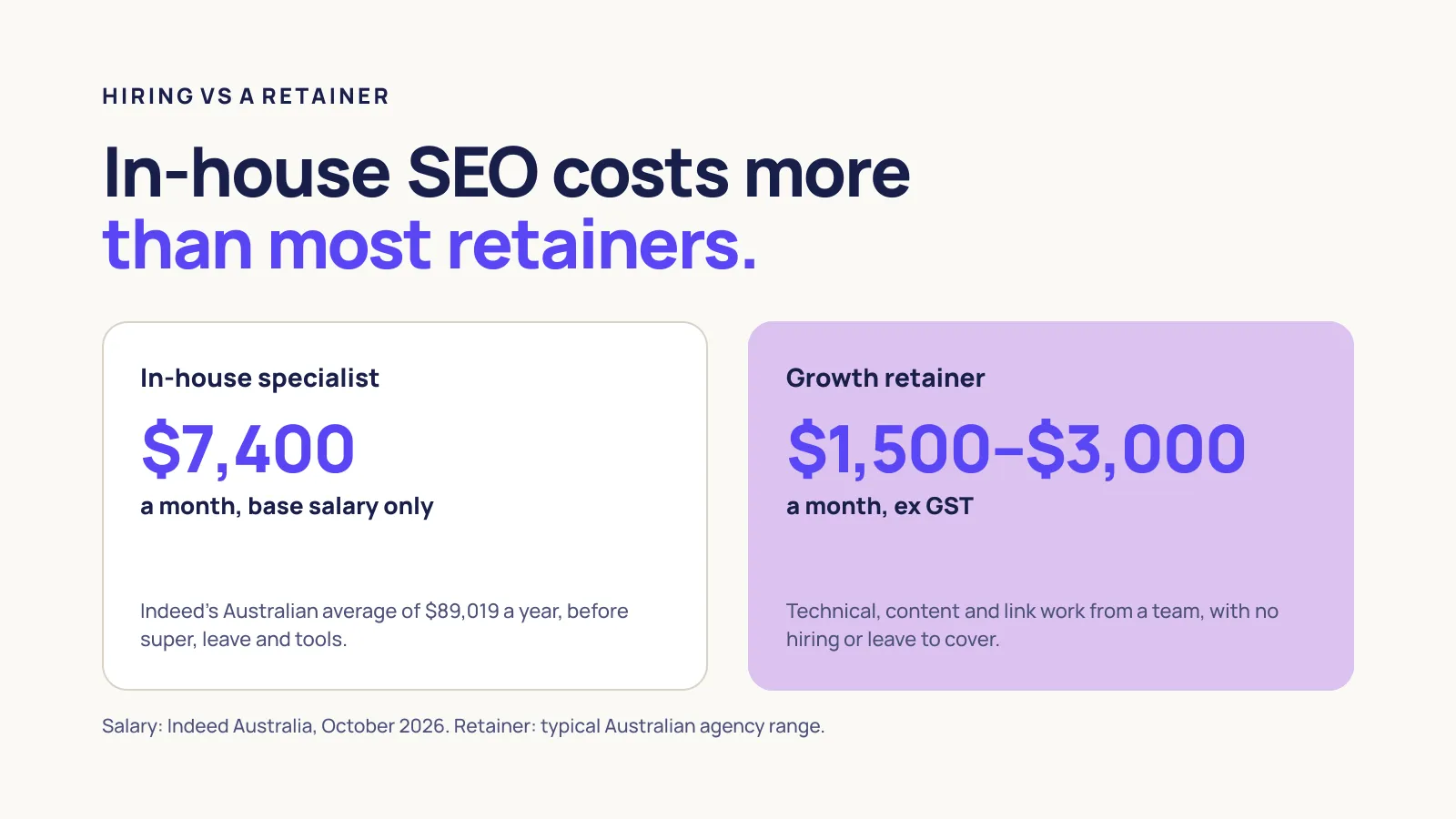
Indeed puts the average Australian SEO specialist salary at $89,019 a year (October 2026, from 62 reported salaries), or $91,795 in Sydney. An SEO manager averages $101,406, from 40 reported salaries. Payscale’s figure for a specialist is lower, at AU$67,635, but it’s based on only 21 profiles.
At the Indeed average, a specialist’s base salary alone is about $7,400 a month. Add superannuation, leave, a laptop and the SEO tools they need, such as Ahrefs or Semrush and Screaming Frog, and you’re paying more than a $5,000 agency retainer before they’ve written a page.
You also get one person’s skills. A good specialist might be strong on content and weak on technical fixes, and nobody covers them when they’re on leave.
Where each option makes sense
An in-house hire makes sense once SEO is a full-time job: a large site, a steady flow of new pages, and a team that can act on recommendations the same week. For most small and medium businesses that point is a long way off.
A freelancer suits a defined job, like an audit or fixing a migration, when you already have someone to make the changes. Ahrefs’ survey of 439 SEO providers (last updated 2024) found $75 to $100 (USD) an hour was the most common rate worldwide, though it doesn’t break out Australia.
An agency suits businesses that need several skills each month (technical, content and links) without hiring for each one. The trade-off is less control over who does the work, so ask by name.
Whichever you choose, ask the same three things: who will do the work, what’s delivered each month, and who makes the changes to the website. A freelancer who can’t touch your CMS and an agency that only sends reports both leave the fixes waiting on someone else.
Where SEO budgets get wasted
In our experience, most wasted SEO spend comes from decisions made before the work starts. Both sides get it wrong.
Client-side mistakes
The most common mistake is buying on the monthly price alone. A $600 package and a $2,500 package can list similar deliverables, but the work behind them is very different. Ask each provider to show you what they delivered for a similar client last month.
The second is paying a retainer to solve a one-off problem. If your rankings dropped because a redesign broke your redirects, you need a migration fix. Twelve months of retainer fees won’t get those redirects back any faster. We see this after website rebuilds more than anywhere else.
The third is judging SEO at month two. Google says some changes take several months to be reflected. An Ahrefs study found only 1.74% of newly published pages reached the top 10 within a year, and the average number-one page was five years old. Plan your budget for six to twelve months.
Agency-side red flags
Ranking guarantees are the clearest one. Google’s own advice is direct: “No one can guarantee a #1 ranking on Google”, and if an SEO promises first place, “find someone else”.
Link packages are the next. In our experience, a quote that promises “20 high-authority backlinks a month” is usually buying them, and Google’s spam policies list “exchanging money for links” as link spam. Ask exactly which sites the links will come from before you sign.
Watch the reports, too. A monthly report full of ranking positions and no enquiries tells you the agency is measuring what it can control, not what you’re paying for. Ask for organic enquiries, calls and form submissions alongside rankings, and check that your tracking actually records them before the first report arrives.
Finally, check what you keep. Before you sign, ask what the minimum term is, whether there’s a set-up fee, and who owns the Google Analytics, Search Console and Business Profile accounts and the content written for you if you leave. Our view is simple: those should all be in your business’s name from day one.
How to set your SEO budget
Work through these before you ask for quotes:
- Check what search already brings in. Pull the last 12 months from Google Search Console and Google Analytics. Note which pages and searches lead to enquiries.
- Work out what an enquiry is worth. Average job value multiplied by your close rate tells you how much a new enquiry is worth, and so what a month of SEO needs to return.
- Look at who you’re up against. Search your main services and note who ranks. National brands and directories mean a bigger budget than a page of local competitors.
- Fix the one-off problems first. If the site has technical or migration issues, budget for an audit and fixes before a retainer.
- Pick a tier. Use the tiers above. If what’s included doesn’t cover the content and fixes your site needs, either raise the budget or narrow the goal to fewer services or suburbs.
- Compare quotes on the same scope. Ask each provider what’s delivered each month, who does the work, the minimum term and whether prices include GST.
If two quotes cover the same work and the same people, the cheaper one is fine. If they don’t, you’re not comparing prices yet.
How AI search changes what you pay for
AI answers are taking clicks from ordinary results. An Ahrefs study of about 300,000 keywords found an AI Overview was linked to a 58% lower click-through rate for the top-ranking page. In a study of US adults, Pew Research found people clicked a normal result in 8% of visits with an AI summary, against 15% without one.
That doesn’t mean you need a separate AI search budget. Google still had 87.9% of Australian search in September 2026, according to StatCounter. In our experience, the pages Google’s AI Overviews quote are mostly clear, well-structured pages that already rank well. Our position: be wary of “GEO” or “AEO” sold as an add-on on top of an SEO retainer. Ask what the extra money does that the SEO work doesn’t.
FAQs
Does Google charge for SEO?
No. Ranking in Google’s organic results is free. What you pay for is the work that helps your site rank: technical fixes, content and links. Google Ads is a separate, paid product where you’re charged for clicks on ads.
Are SEO prices in Australia quoted with GST?
Usually not. Most agencies quote SEO pricing ex GST, so add 10% to compare quotes fairly. If your business is registered for GST you can generally claim that 10% back, but check with your accountant.
Is SEO cheaper than Google Ads?
They’re paid for differently. Google Ads charges for every click, and the traffic stops when you stop paying. SEO costs a monthly fee for the work, and the rankings it builds keep bringing in visits without a cost per click. In our experience, many businesses use ads for enquiries now and SEO to lower the cost of each enquiry over time.
What’s included in an SEO audit?
A good SEO audit checks how Google crawls and indexes your site, page speed and Core Web Vitals, titles and headings, content gaps against competitors, and the links pointing to your site. Auditors usually work from Google Search Console and a crawler such as Screaming Frog. The result should be a prioritised list of fixes, not just a score.
Can I do SEO myself instead of paying for it?
Yes, for the basics. Setting up Google Business Profile, writing clear service pages and fixing obvious problems found in Search Console doesn’t need an agency. Paying for SEO makes sense once you need technical fixes, regular content or link building that you don’t have the time or skills to do well.
Next steps
- Ready to talk? Tell us about your website and we’ll tell you honestly whether it needs a one-off fix or ongoing SEO. Contact Webhaus
- Comparing options? See what each kind of work involves on our AI search and SEO services page.
- Still learning? Start with What are SEO services?, our plain-English guide to the seven types of SEO work.
Before you compare SEO pricing, ask every provider the same question: what exactly do I get each month, and who does it? The answer tells you more than the price.