
A customer mentions they found a competitor “through ChatGPT”. A week later an agency offers you an AI SEO package built around an llms.txt file and new schema. You’re left wondering whether your SEO is now out of date, and what any of it would change.
What is AI SEO, then, and does your business need to do anything different? Below is the plain answer: what changes from normal SEO, what traffic AI search actually sends, and what we’d skip.
What is AI SEO? AI SEO is optimising your website and your wider online presence so AI tools name and cite your business in their answers. Those tools include ChatGPT, Google’s AI Overviews and AI Mode, Gemini and Perplexity. It’s also called generative engine optimisation (GEO) or answer engine optimisation (AEO). It uses the same foundations as SEO, plus answers written so a tool can quote them, consistent facts about your business across the web, and tracking of what those tools say.
In this guide
- What AI SEO is, what changes and what it costs
- Where AI SEO goes wrong
- How to start: six checks for this month
- You still need normal SEO
What AI SEO is, what changes and what it costs
“AI SEO” means two different things
The term gets used for two unrelated jobs. One is optimising for AI search: getting your business named in ChatGPT and Google’s AI answers. The other is using AI tools to do SEO work faster, such as clustering keywords or drafting briefs. When we checked in November 2026, about half of Google’s top results for “AI SEO” in Australia were lists of AI SEO tools.
This guide is about the first meaning. If an agency quotes you for “AI SEO”, ask which one they mean.
What carries over from SEO
Google is direct about this. Its documentation for site owners says there are “no additional requirements to appear in AI Overviews or AI Mode”, and no special schema.org structured data you need to add. It also says you don’t need “new machine readable files, AI text files, or markup”. A page still has to be indexed and eligible to show in Google Search with a snippet.
So the basics carry over: a site Google can crawl, pages that match what people search, and other sites vouching for you. What ranking alone doesn’t do is get you cited. An Ahrefs study of 15,000 prompts found only 12% of links cited by ChatGPT, Gemini and Copilot appeared in Google’s top 10 for the same prompt. Google’s own AI Overviews are the exception: in the same study, 76% of their citations came from top-10 pages.
What actually changes
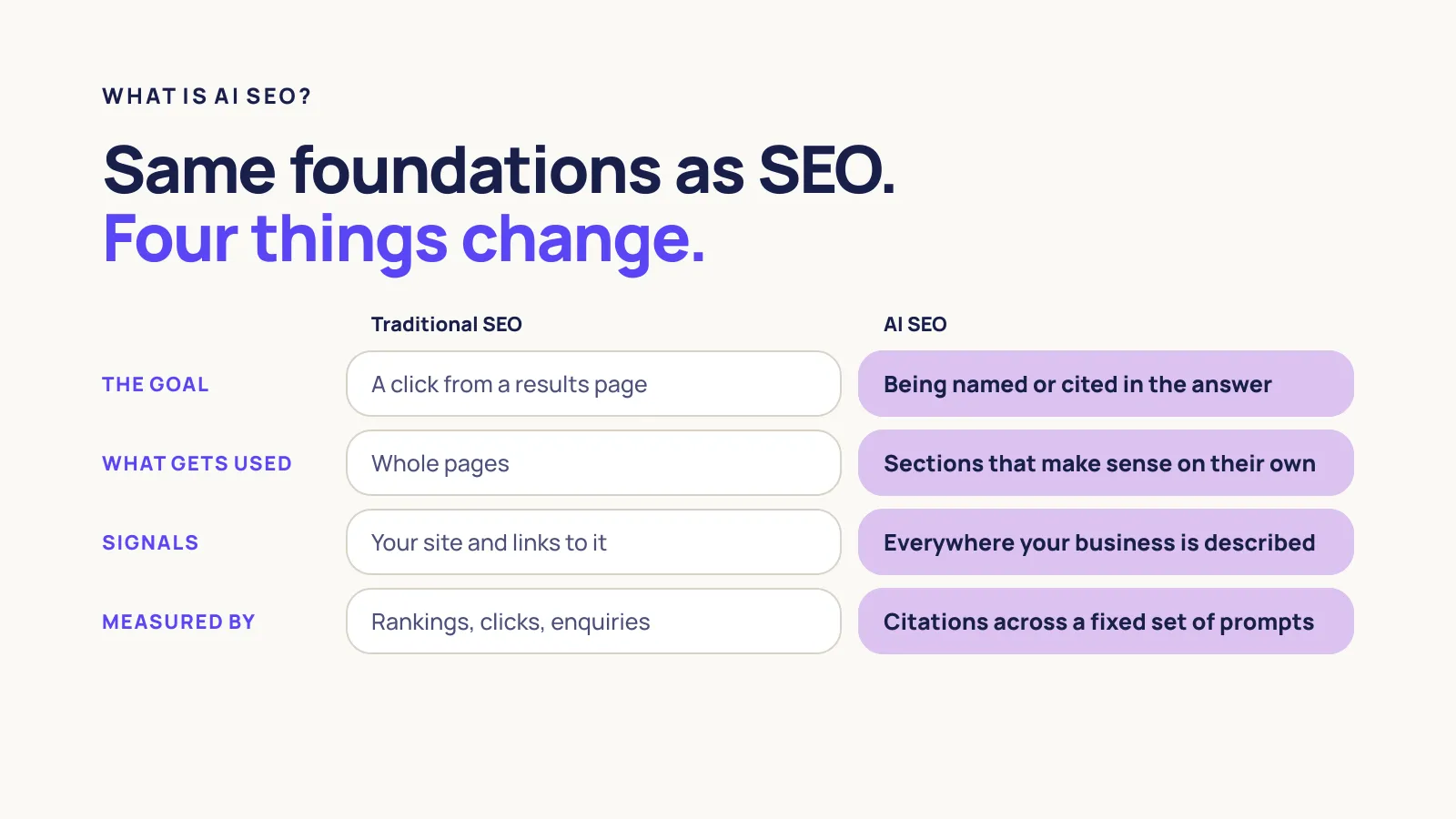
| Traditional SEO | AI SEO | |
|---|---|---|
| The goal | A click from a results page | Being named or cited in the answer |
| Where | Google’s results | ChatGPT, AI Overviews, AI Mode, Gemini, Perplexity |
| What gets used | Whole pages | Sections that make sense on their own |
| Signals | Your site and links to it | Also every other place your business is described |
| How you measure it | Rankings, clicks, enquiries | Citations and mentions across a fixed set of prompts |
The third row is the one most sites get wrong. An AI tool usually quotes a paragraph, not a page, so each section needs to answer its own question without the section before it.
How much traffic AI search actually sends
Less than the hype suggests, for now. Similarweb found the share of US ChatGPT answers that include a citation rose from about 1.6% in June 2025 to about 6.8% by May 2026. For professional services it was under 4%.
The bigger change for most Australian businesses is on Google itself. Ahrefs measured a 58% lower click-through rate for the top result when an AI Overview appears. A 2025 US study by Pew Research found people clicked a result in 8% of visits with an AI summary, against 15% without one. Being the source the summary names is how you keep some of that attention.
What it costs in Australia
We don’t price AI SEO as a separate service. It’s part of our SEO services, because the work is the same work as SEO done properly. Most small and medium businesses in Australia pay $1,500 to $3,000 a month for SEO, though it depends heavily on the site and the competition. Our guide to SEO pricing in Australia breaks that down. If an agency quotes AI SEO as an add-on, ask what it includes that their SEO plan doesn’t.
Where AI SEO goes wrong
Selling llms.txt and schema as the fix
This is the most common thing we see sold as AI SEO. llms.txt is a proposed file that summarises your site for AI tools. Google’s John Mueller said in June 2025 that “no AI system currently uses llms.txt”, and Google’s own documentation says you don’t need AI text files. Publishing one does no harm, but we wouldn’t pay for it.
The same goes for schema sold as an AI lever. Gemini told us to put our ABN and prices in schema; Google says no special structured data is needed. Schema is still worth having for normal search results. It just isn’t the thing that gets you named.
Blocking the wrong crawler
AI companies run separate bots for search and for training. OpenAI’s OAI-SearchBot finds pages for ChatGPT search, and OpenAI says sites that block it “will not be shown in ChatGPT search answers”. GPTBot collects training data, and you can block it without leaving ChatGPT search.
A business that blocks “all AI bots” to protect its content usually drops out of the answers too. Check what your host or CDN blocks by default, not just your robots.txt.
Text the crawler can’t see
If your page’s text only appears after JavaScript runs, many AI tools never see it. Vercel’s analysis found none of the major AI crawlers rendered JavaScript at the time, including OpenAI’s and Anthropic’s. View the source of your main service page. If the words aren’t there, the crawler doesn’t see them either.
Promises nobody can keep
AI answers change from one run to the next, and between tools. Nobody can guarantee you’ll be recommended by ChatGPT. Any agency promising that is promising something it doesn’t control. Ask instead what they’ll measure, how often, and across which tools.
How to start: six checks for this month
You can do the first four yourself in an afternoon.
- Ask the tools. Put 10 questions your customers ask into ChatGPT, Gemini and Google’s AI Mode, twice each. Write down who gets named and which pages get cited.
- Check your crawler settings. Make sure Googlebot, Bingbot, OAI-SearchBot, PerplexityBot and Claude-SearchBot are allowed in robots.txt and not blocked by your host or Cloudflare settings. Submit your sitemap to Bing Webmaster Tools too, because Microsoft’s Copilot answers come from Bing.
- View the source. Open your main service page, view the page source and search for a sentence from it.
- Fix your facts. Make sure your Google Business Profile, directory listings and About page describe what you do now, with the same name, address and services.
- Rewrite the top of your key pages. Answer the page’s question in the first 50 words, with plain wording a tool can quote.
- Measure monthly. Track AI citations with a tool like Ahrefs or Semrush, and rerun the same prompts each month. In GA4, check referrals from chatgpt.com, perplexity.ai and gemini.google.com.
You still need normal SEO
AI Overviews and AI Mode draw on pages Google has already indexed, and Google reports their traffic inside the normal Search Console Performance report, under the “Web” search type. There’s no separate AI channel to switch on. A site that does well in Google has most of what AI search needs. The extra work is making each answer easy to quote and making sure your business is described the same way everywhere.
FAQs
Is AI SEO the same as GEO or AEO?
Mostly, yes. Generative engine optimisation (GEO), answer engine optimisation (AEO) and AI SEO all describe getting cited in AI answers. Some people use AEO for featured snippets and voice answers specifically, but in practice the work overlaps almost completely.
Can I see how much traffic ChatGPT sends me?
Partly. In Google Analytics 4, open the Traffic acquisition report and look for sessions from chatgpt.com, perplexity.ai and gemini.google.com. Clicks from Google’s AI Overviews and AI Mode are counted with normal Google search traffic, so you can’t separate them there.
Should I block AI crawlers to protect my content?
Only the training ones, if that matters to you. Blocking GPTBot or ClaudeBot stops your content being used for training without removing you from those tools’ search answers. Google-Extended doesn’t affect Google Search, but blocking it can also keep your pages out of answers in the Gemini app. Blocking search bots such as OAI-SearchBot or PerplexityBot removes you from those tools’ answers.
Next steps
Ready to talk? If you want to know how AI tools describe your business today, get in touch and we’ll run the prompts and show you who gets named instead.
Comparing options? See what’s included in our SEO services, including AI search.
Still learning? Read what SEO services are, including technical, local and content SEO.
What is AI SEO worth to your business? Find out by asking the tools your customers use, before you pay anyone to change your site.